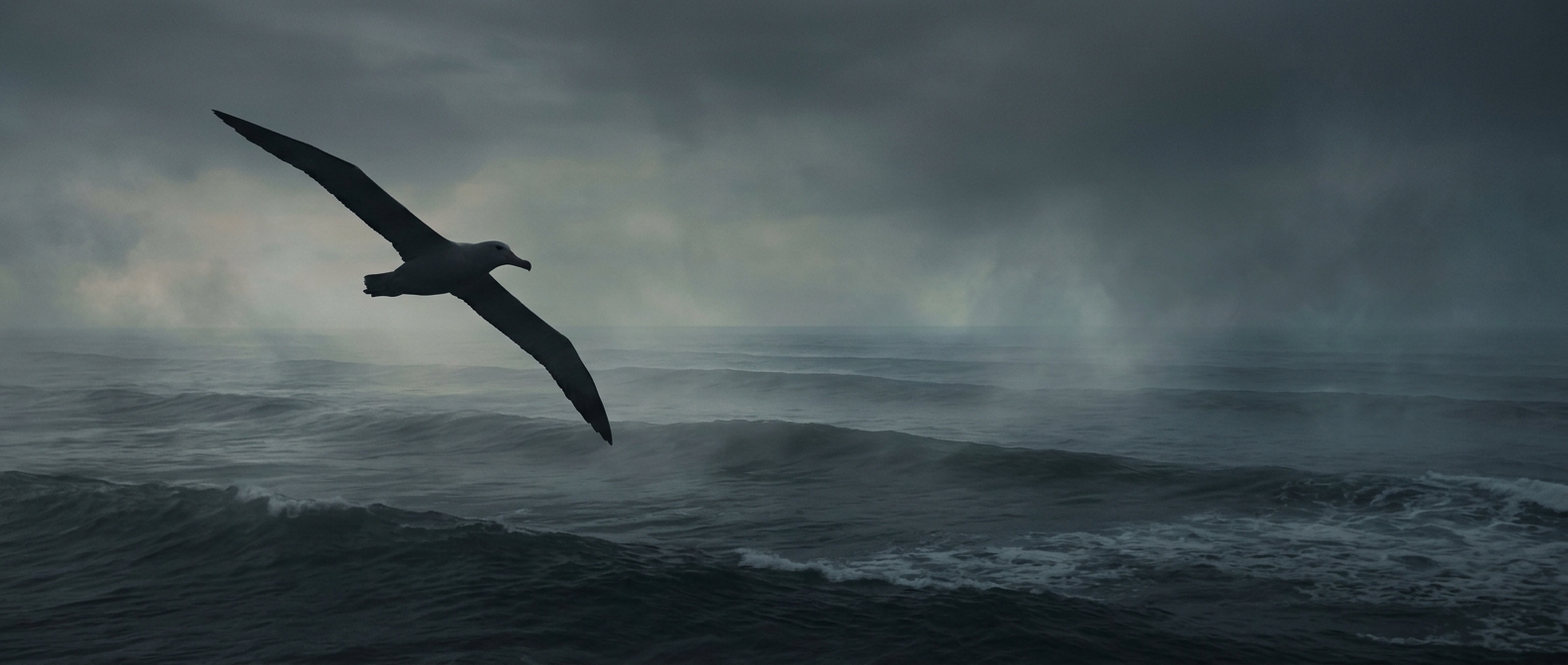
The wind is an invisible staircase over the sea
An albatross does not have to flap constantly to keep moving. Its long, narrow wings are built for efficient gliding, and a tendon arrangement at the shoulder helps hold them extended with little muscular effort. The bigger trick is using wind that changes speed with height above the ocean.
That change creates a kind of aerial staircase. Close to the water, friction slows the wind; a little higher up, it is often moving faster. By crossing between those layers in a repeated pattern, an albatross can take energy from the wind and turn it into forward motion. This technique is called dynamic soaring.
A looping route that gains energy
The bird may sweep low across the water, turn into the wind, and climb into faster-moving air. Higher up, it turns downwind and descends toward the slower layer. Each crossing helps restore speed lost to drag, so the bird can cover distance without the steady flapping that would otherwise cost far more energy.
The path is not a straight line: it is a series of sweeping turns, adjusted to the wind. Waves and changing conditions can alter the best route, and the bird still flaps when needed. But over open water, where there may be nowhere to perch, exploiting wind is an efficient way to travel between feeding areas.
The ocean shapes the journey
For an albatross, wind is not merely weather to endure; it is part of the propulsion system. A route that looks indirect on a map may let the bird repeatedly cross the layers that provide lift and speed. The result is a striking travel advantage: an ocean crossing can be powered less by muscle than by skillful movement through the air.