When the Sky Became an Unplanned Power Source
A 19th-century telegraph did not need a power plant at both ends. In many systems, a battery pushed current through a long wire; at the far end, that current activated an electromagnet, which moved a lever or made a click. The circuit often completed through the ground, so the earth itself served as the return path.
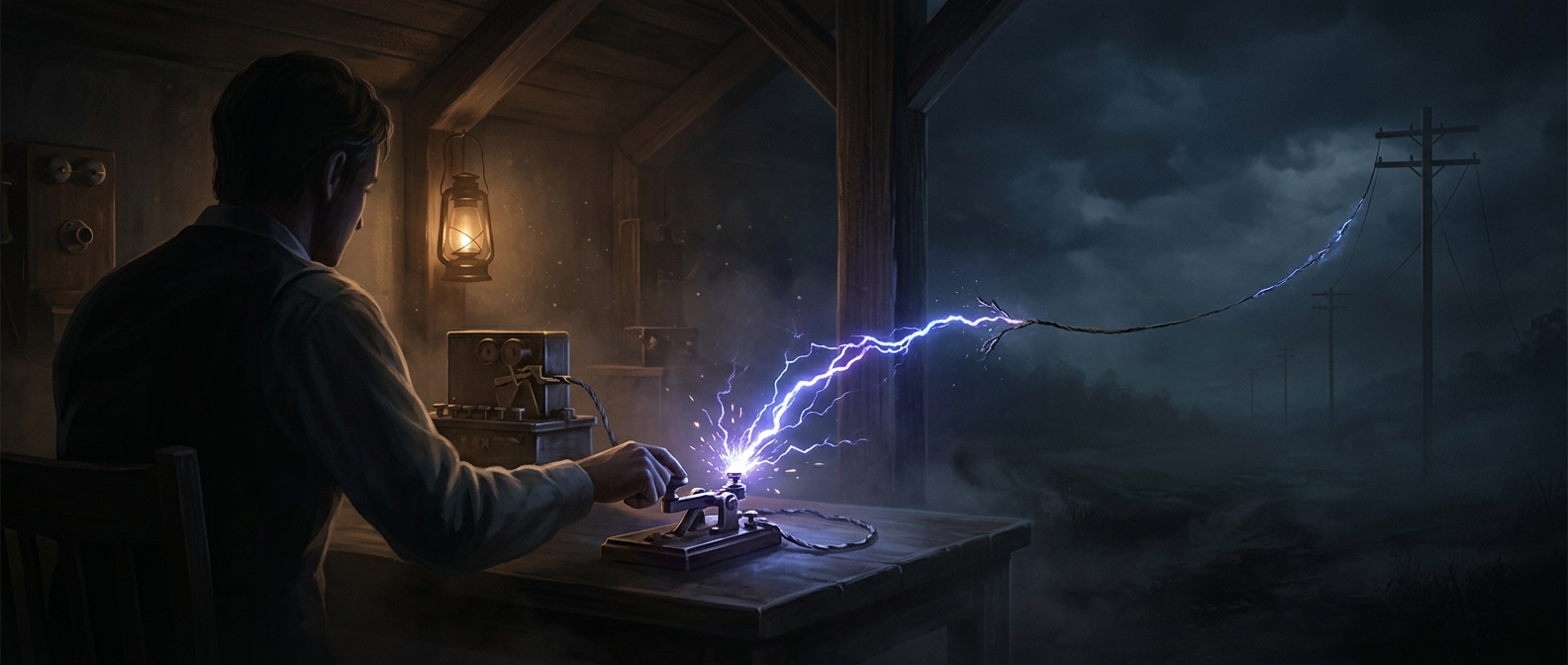
That arrangement also left the wire exposed to electrical conditions in the atmosphere. A long telegraph line could pick up charge from nearby storms or changing atmospheric electricity. If the resulting current was strong enough, it could operate the receiving mechanism—even when the station’s battery was disconnected or failing.
A Message, Not a Dependable Supply
For an operator, the crucial question was whether the current could be controlled. Telegraph messages depended on deliberately timed pulses: short and long signals that a receiver could register as dots and dashes, or as clicks. A natural current was not a steady replacement for a battery, but under favorable conditions an operator could use available electrical current to send signals along the line.
Lightning was the dramatic version of the problem, not a practical power source. A strike could produce a powerful surge, but it was unpredictable and could overwhelm equipment. More modest atmospheric currents could also interfere with signals or make instruments behave unexpectedly. Operators had to distinguish an intentional message from electrical noise—and protect delicate apparatus from surges.
The episode reveals an early engineering tradeoff: the long wire that carried messages also collected electricity from its surroundings. A telegraph line could sometimes keep communication going on nature’s current, but the same openness that made that possible made the current unreliable and potentially destructive.