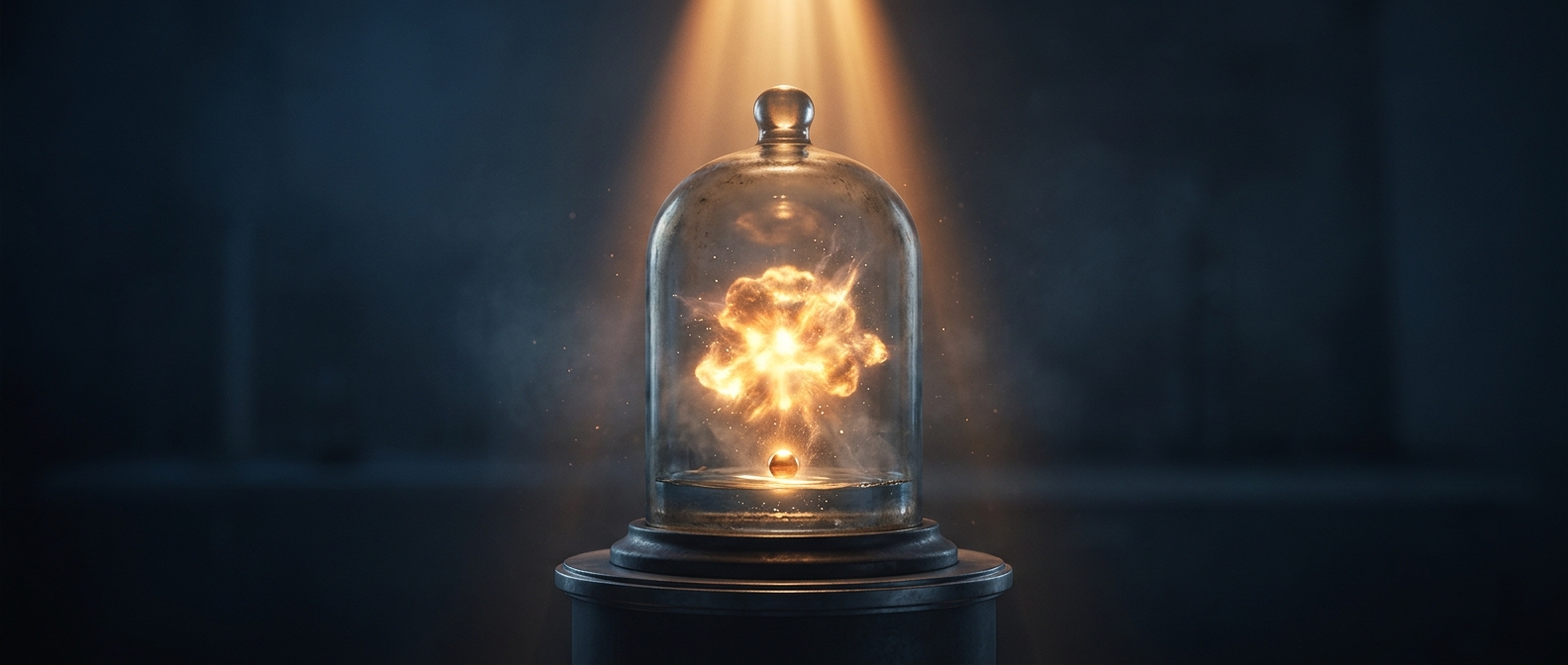
Why francium is expected to flare up in water
Francium sits at the bottom of the alkali-metal column, whose members have one easily removed outer electron. In water, that electron can be transferred to water molecules. The reaction forms hydrogen gas and a metal hydroxide, while releasing heat.
That heat can speed the reaction and ignite the hydrogen, making contact between water and an alkali metal violently energetic. Alkali metals generally become more reactive down the column, which is why francium is expected to react especially strongly. The prediction follows from its place in the periodic table and the chemistry of its relatives—not from a dramatic beaker test.
Why there is no francium demonstration
Francium is extraordinarily scarce and radioactive. It occurs naturally only in tiny traces as part of radioactive decay chains, and its longest-lived isotope has a half-life of about 22 minutes: after that time, half of a sample’s atoms have decayed. Any francium made for study also disappears through radioactive decay, leaving no practical way to accumulate a visible lump.
A reaction with a handful of atoms would not resemble the familiar demonstrations in which a solid piece of metal skitters across water or bursts into flame. Researchers can study francium in minute quantities, but the quantities and short lifetime rule out collecting enough for that kind of experiment.
A prediction with a physical limit
The likely chemistry is still meaningful: francium’s position among the alkali metals points to a powerful reaction with water. But the popular image of a chunk exploding in a beaker joins a sound chemical expectation to an experiment that cannot realistically be performed. For francium, the periodic table predicts the spectacle; scarcity and radioactive decay keep it out of the lab demonstration.