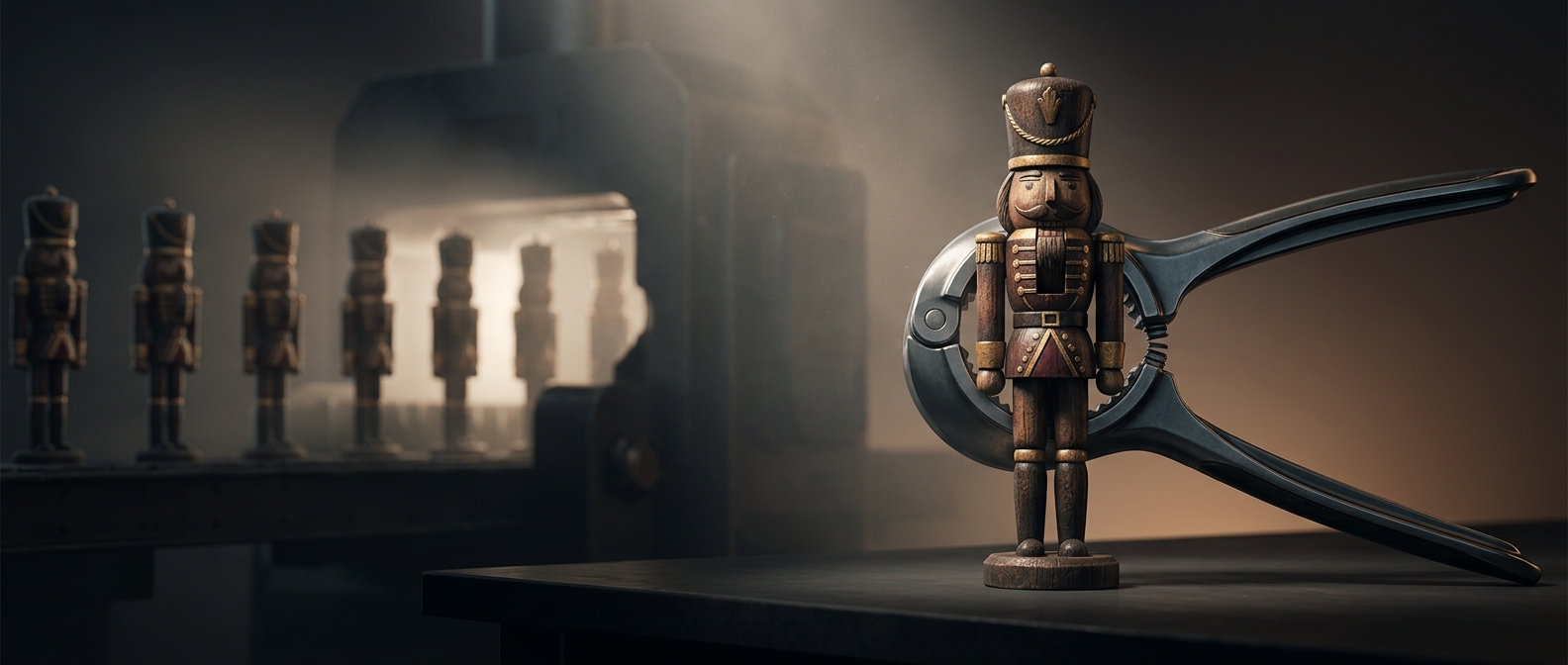
A small lever turns a hand’s squeeze into a crack
In a traditional lever-action nutcracker, the nut sits between two jaws near a hinge. Pressing the handles together makes the jaws close on the shell. Because the nut is close to the pivot, the jaws can press hard even when the handles move farther and require less force from the hand. That is the basic advantage of a lever: it trades distance for force.
The shell gives way when the pressure at the jaws exceeds what its brittle outer layer can withstand. Once it cracks, the force can be eased so the kernel inside is less likely to be crushed. The tool’s job is not simply to squeeze as hard as possible, but to concentrate force on a shell and stop once it breaks.
The familiar face is also part of the mechanism
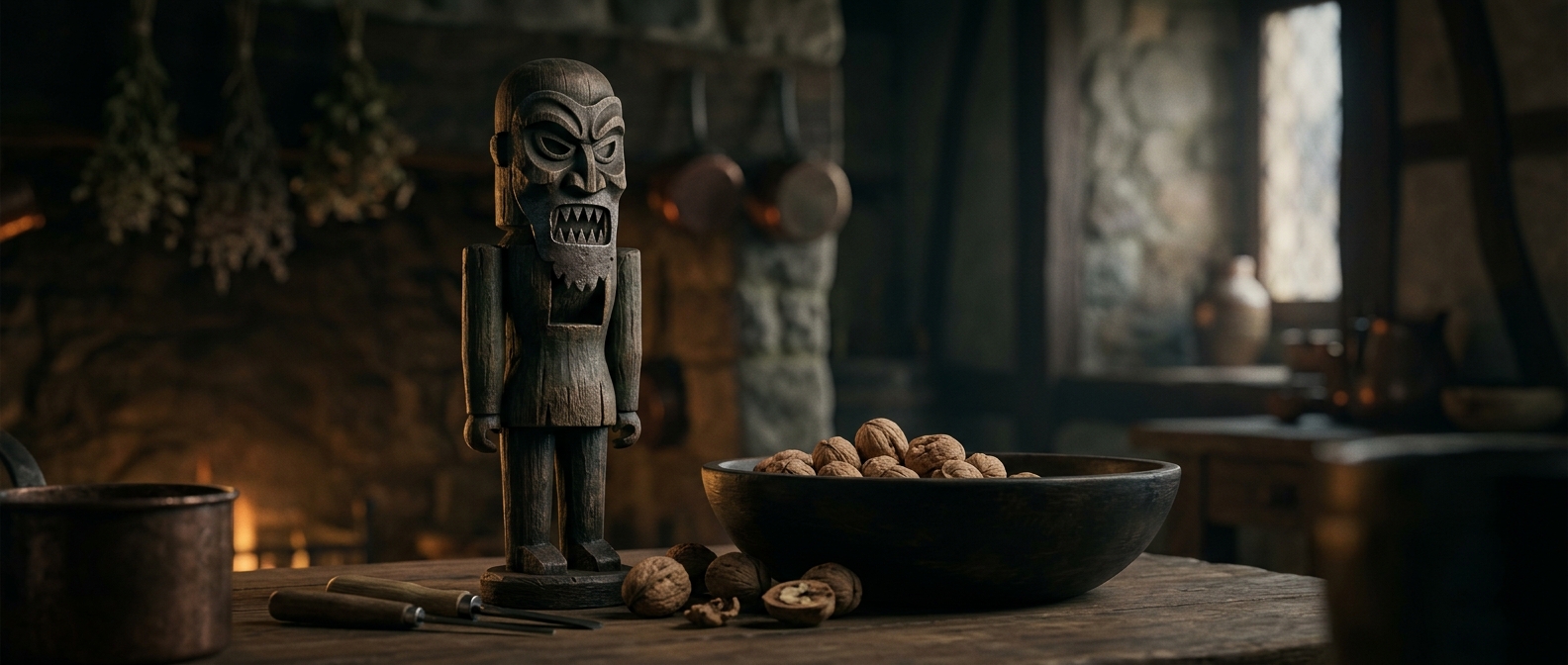
On the classic wooden nutcracker figure, the lever is built into the back of the head. A nut rests in the open mouth; pushing the lever down moves the lower jaw upward against it. The face makes the action easy to see, but the working parts are ordinary mechanics: a pivot, two moving arms, and a load held between the jaws.
That arrangement also explains why these figures can be more charming than convenient. A rigid jaw may work well for some nuts but fit others poorly, and a short jaw movement offers less control than a tool designed solely for cracking. The decorative figure preserves a useful motion in a memorable shape—one press of the lever, and the mouth closes around the shell.