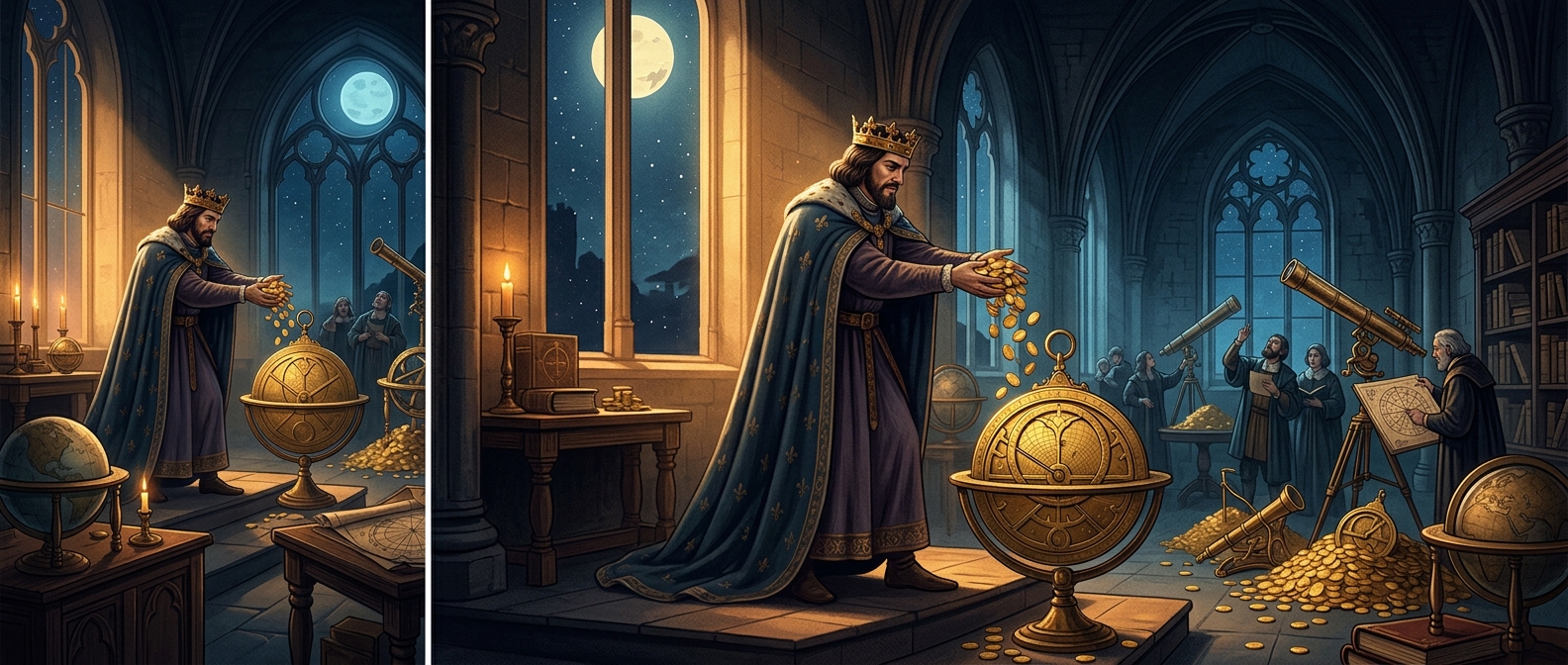
Why a king would fund star readers
In the 14th century, astrology was not neatly separated from astronomy. Both involved observing the heavens and calculating the positions of the planets; astrology added the claim that those positions could reveal what lay ahead. To a royal court, that promise could make star charts seem like a tool of government, useful for choosing auspicious moments or anticipating danger.
A college devoted to astrology therefore represented more than a private interest in horoscopes. It gave the subject an institutional home and signaled that the crown considered celestial prediction worth studying. But a formal academy could produce expertise only within the limits of the ideas and methods it taught. It could not make predictions dependable simply by giving them royal support.
What the charts could not do
The Hundred Years’ War was shaped by practical forces: armies had to be supplied, fortified places had to be taken or held, and commanders had to respond to events on the ground. A forecast based on planetary positions could not move provisions, reinforce a threatened town, or stop an invading force. Even if royal astrologers advised the king, their work offered no reliable substitute for those decisions.
That is the gap behind the college’s disappointing military legacy. Charles V’s investment could establish astrology as a learned pursuit, but it could not turn celestial calculations into a way to control the war. The contrast is striking: a kingdom could build an institution to study the heavens while the outcome of its conflict still depended on earthly supplies, soldiers, and strategy.