A New Yorker built a magician’s Chinese identity
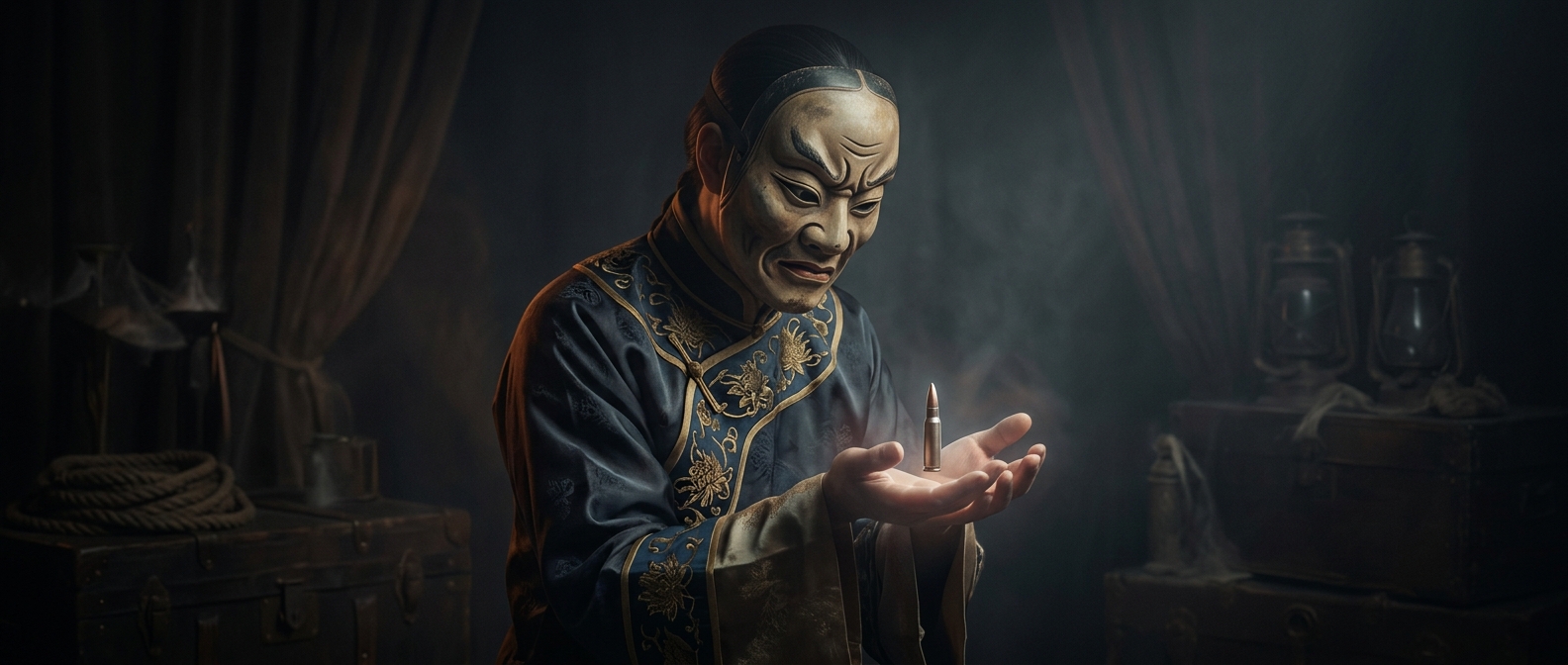
Chung Ling Soo was the stage name of William Ellsworth Robinson, an American magician from New York. He performed as a Chinese conjurer, using makeup and costume to sustain the illusion and relying on fake translations rather than speaking directly to audiences. The persona was not a brief disguise: it became the frame through which audiences encountered his entire act.
That framing mattered in an era when “exotic” stage identities were sold as spectacle. Robinson’s carefully maintained character made the performance seem to come from a distant tradition, even though the performer behind it was American. The contrast between the advertised identity and the man beneath it remained hidden for years.
The trick depended on control—and one failure was fatal
The bullet catch was among the most dangerous illusions in magic. A performer appeared to catch a fired bullet, often presenting it afterward as proof. The effect depended on tightly controlled weapons, ammunition, timing, and handling: the audience had to see a convincing shot without a real bullet reaching the performer.
In 1918, during a performance in London, a gun discharged and Robinson was struck. The trick’s central illusion had become a real shooting. He died onstage, and his final words were spoken in English—a stark break from the Chinese persona he had maintained throughout his career.
The accident exposed two layers of the act at once: the physical risk hidden inside a seemingly impossible stunt, and the constructed identity that had concealed Robinson’s actual background. The man presented as a Chinese magician was a New Yorker; in the final moments, the performance fell away.