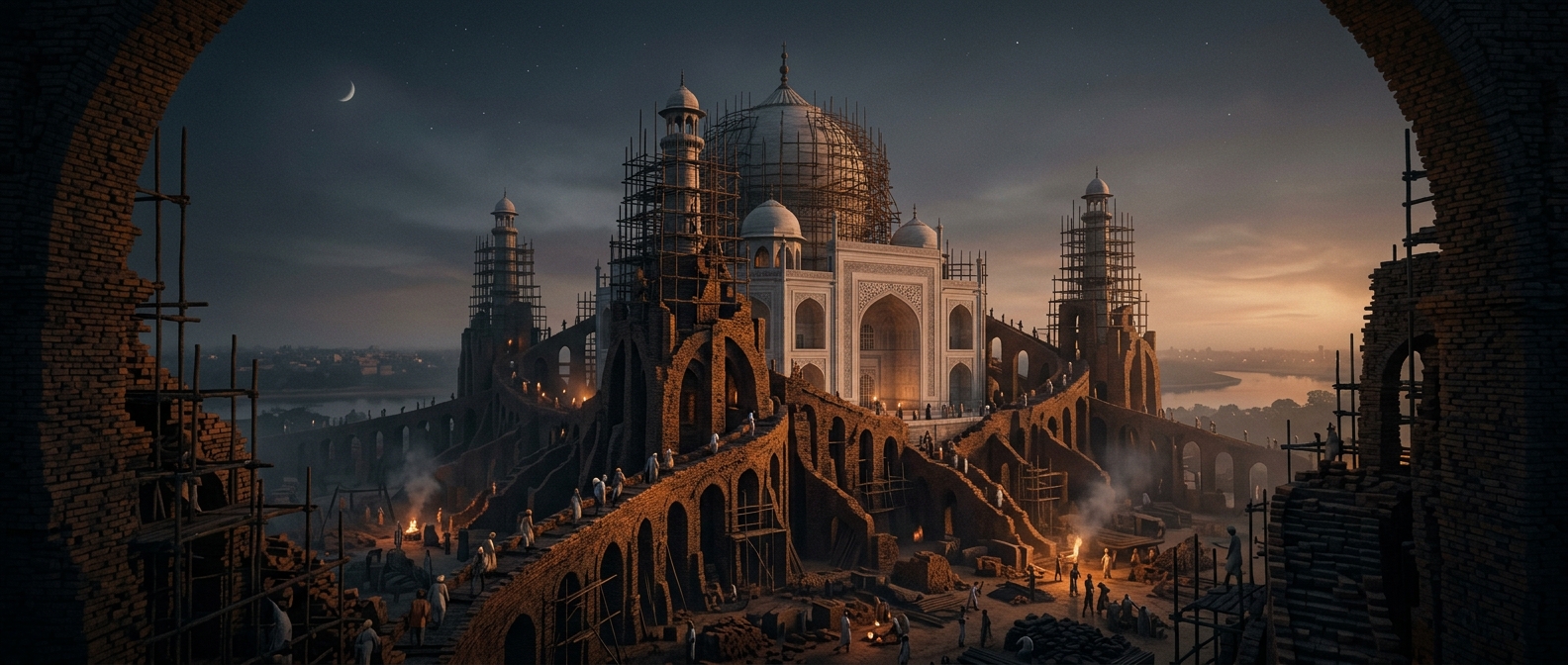
Why the dome needed a temporary brick mountain
A monumental masonry dome cannot simply be raised in open air. Its courses—rings of brick or stone—must be supported while they are laid; only when the structure is complete can the weight pass safely through the finished arch. Builders also need a way to reach high sections and move materials into place. At the Taj Mahal, temporary brickwork provided that support and access on a scale large enough to dominate the view of the building.
The arrangement solved a construction problem but created a second one: all that temporary material had to come down without damaging the finished mausoleum. Dismantling a vast mass by ordinary labor would have been slow and costly, and the bricks still had value.
Turning demolition into a local resource
The solution described in the account was to let nearby residents keep the bricks they removed. That offer changed the teardown from a one-way expense into a useful exchange: workers cleared the construction supports, while households gained building material. The Taj Mahal’s builders did not need to haul every brick away themselves, and locals had a direct reason to take the structure apart.
It is a striking reminder that monumental architecture depends on temporary works as much as on the finished stone. The brick mountain was meant to disappear; its removal became part of the project’s practical legacy, with pieces of the construction effort going back into the surrounding community.