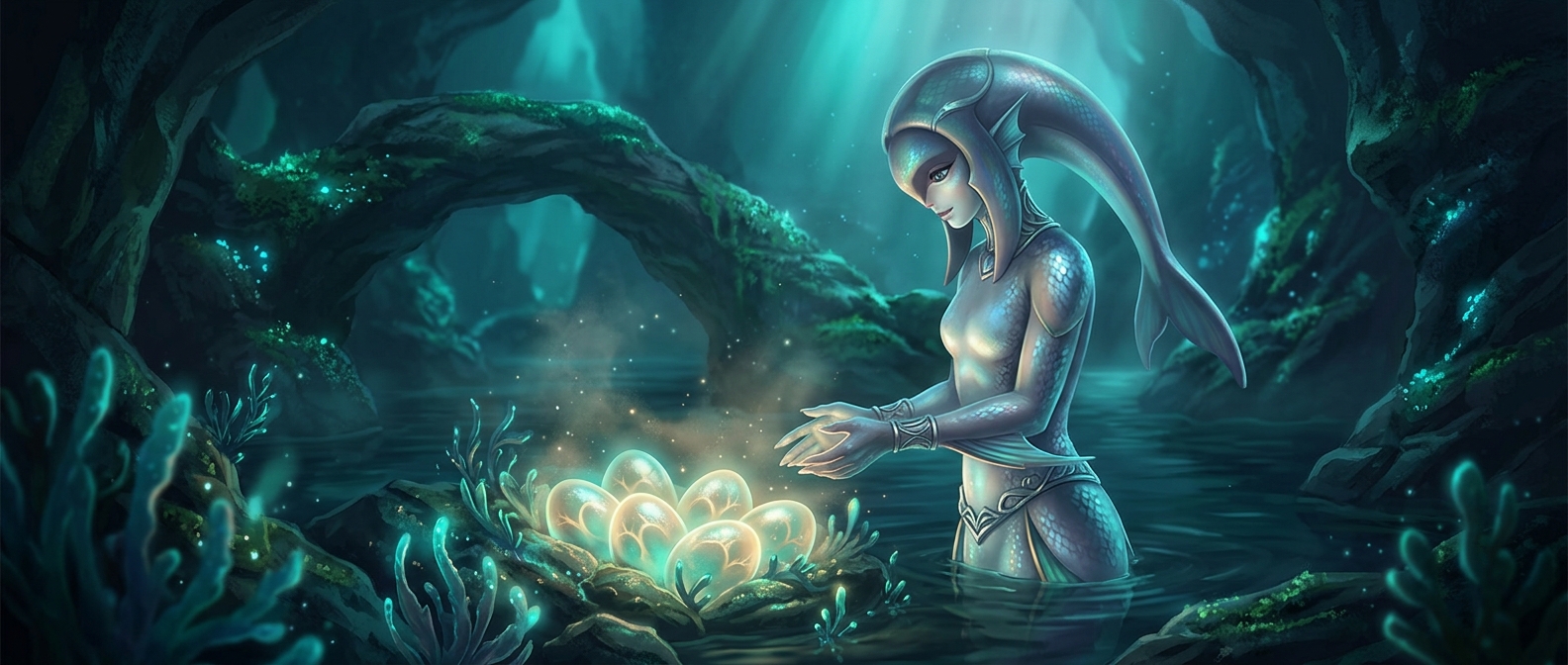
A humanlike society with an unmistakably aquatic life cycle
The fish people’s everyday resemblance to humans—upright bodies, spoken English, and elaborate silver jewelry—sets up an expectation that they will reproduce in familiar ways. The giant, jellylike eggs break that expectation. They make the species feel less like humans in fish costumes and more like beings whose biology follows a different logic.
That contrast is effective worldbuilding: culture and anatomy do not have to match. Jewelry suggests taste, craft, and social meaning; eggs suggest a life cycle shaped by water. The two details occupy the same scene, asking the viewer to accept both a recognizable society and an unfamiliar form of reproduction.
Why put the eggs in a laboratory tank?
A tank turns an odd biological detail into a practical problem. Jellylike eggs are visibly delicate, and a controlled aquatic environment implies that keeping them alive may require care. The laboratory setting also changes the mood: reproduction, normally private or communal, becomes something observed and managed.
That image leaves room for a tension between protection and control without explaining it away. The eggs may need the tank, but the tank also makes them look like specimens. Their scale makes the contrast hard to miss: a species that can walk and speak like people still begins life in a form that belongs unmistakably to the water.