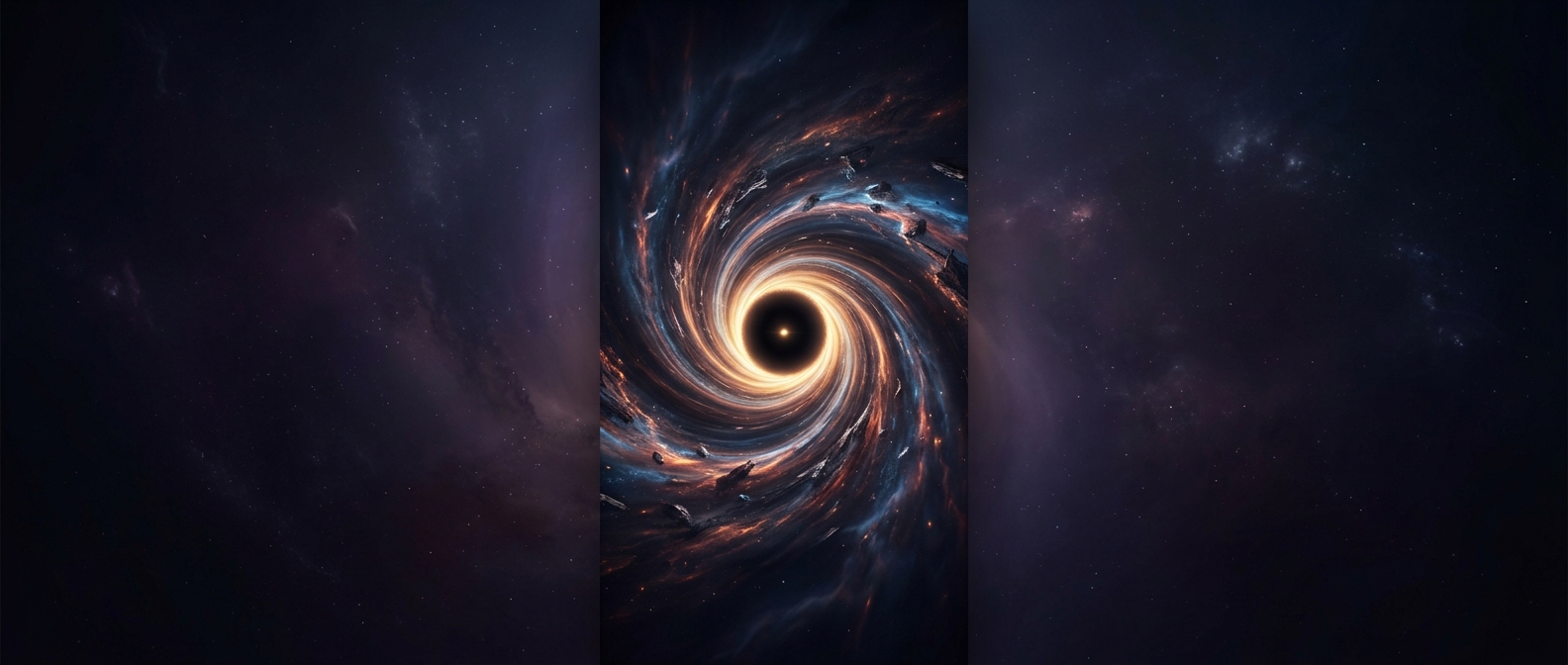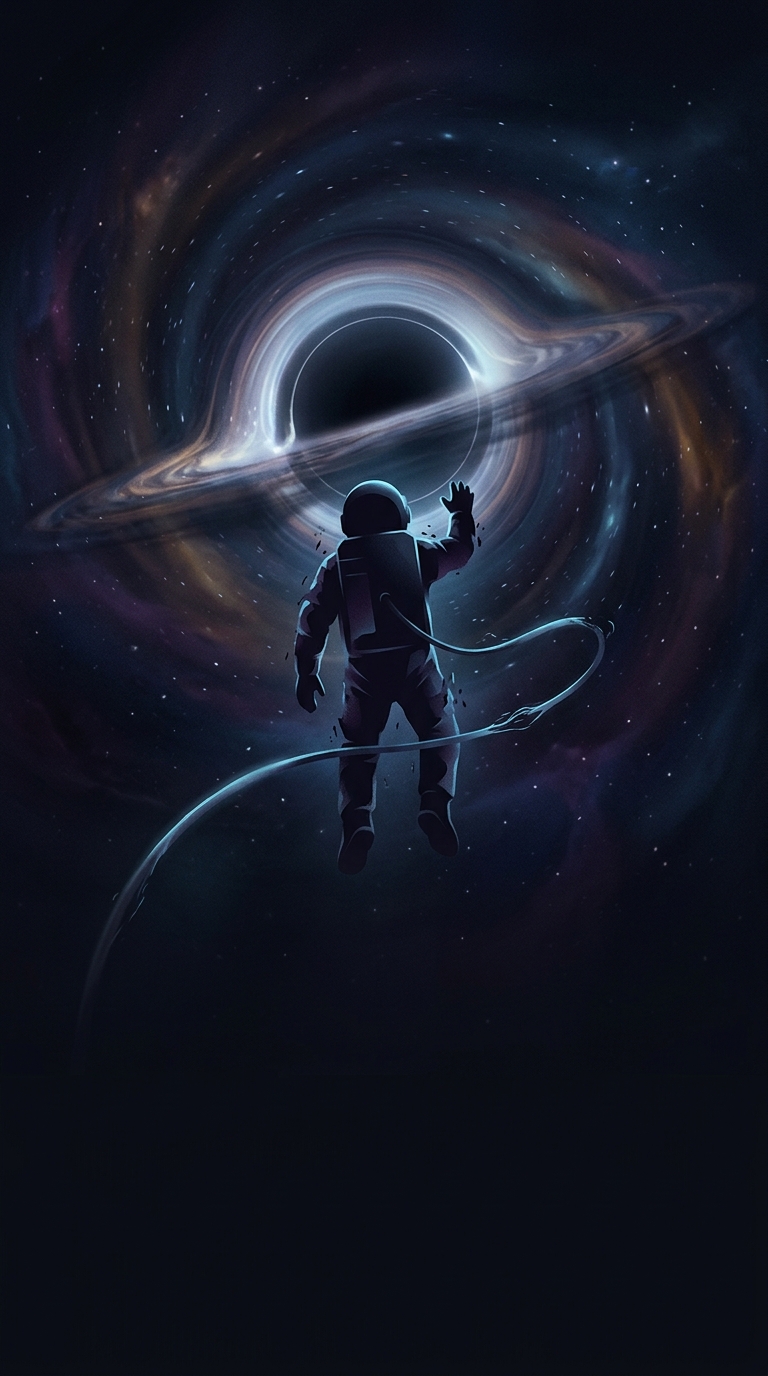
How a black hole can lose mass without anything escaping
A black hole’s boundary, called the event horizon, marks the point beyond which nothing can return to the outside universe. Hawking radiation does not come from matter or light climbing out from inside that boundary. It arises from quantum effects in the region around it, where gravity and the rules of quantum physics interact.
To a distant observer, those effects make the black hole behave as if it emits heat. That radiation carries energy away. Because mass and energy are interchangeable, losing energy means the black hole loses mass too. Given enough time, the process can shrink it away entirely.
Why the fade is so slow
The smaller a black hole is, the hotter it is expected to be and the faster it radiates. A black hole formed from a collapsed star is enormous by comparison with the tiny black holes that would radiate more intensely. Its Hawking radiation would be extraordinarily faint, and its predicted evaporation time vastly exceeds the age of the universe.
That faintness is why Hawking radiation remains a theoretical prediction rather than a directly observed signal from an astrophysical black hole. The surrounding universe is not a clean laboratory: detecting such a weak glow against other sources is far beyond current observations.
The universe’s most extreme objects are not eternal
The prediction connects two otherwise very different ideas: gravity’s one-way boundary and quantum physics’ restless behavior. A black hole can look like a permanent cosmic trap, yet it is not expected to keep its mass forever. Its final fade is not a dramatic explosion so much as an unimaginably prolonged loss of energy—so slow for a stellar black hole that the universe has not had time to show us the process.