The game tree grows faster than computers can search
To solve chess in the strict sense is to determine the perfect result from the starting position: whether flawless play leads to a win for White, a win for Black, or a draw. That requires accounting for every legal sequence of moves—not merely finding a strong move in the positions that arise during ordinary play.
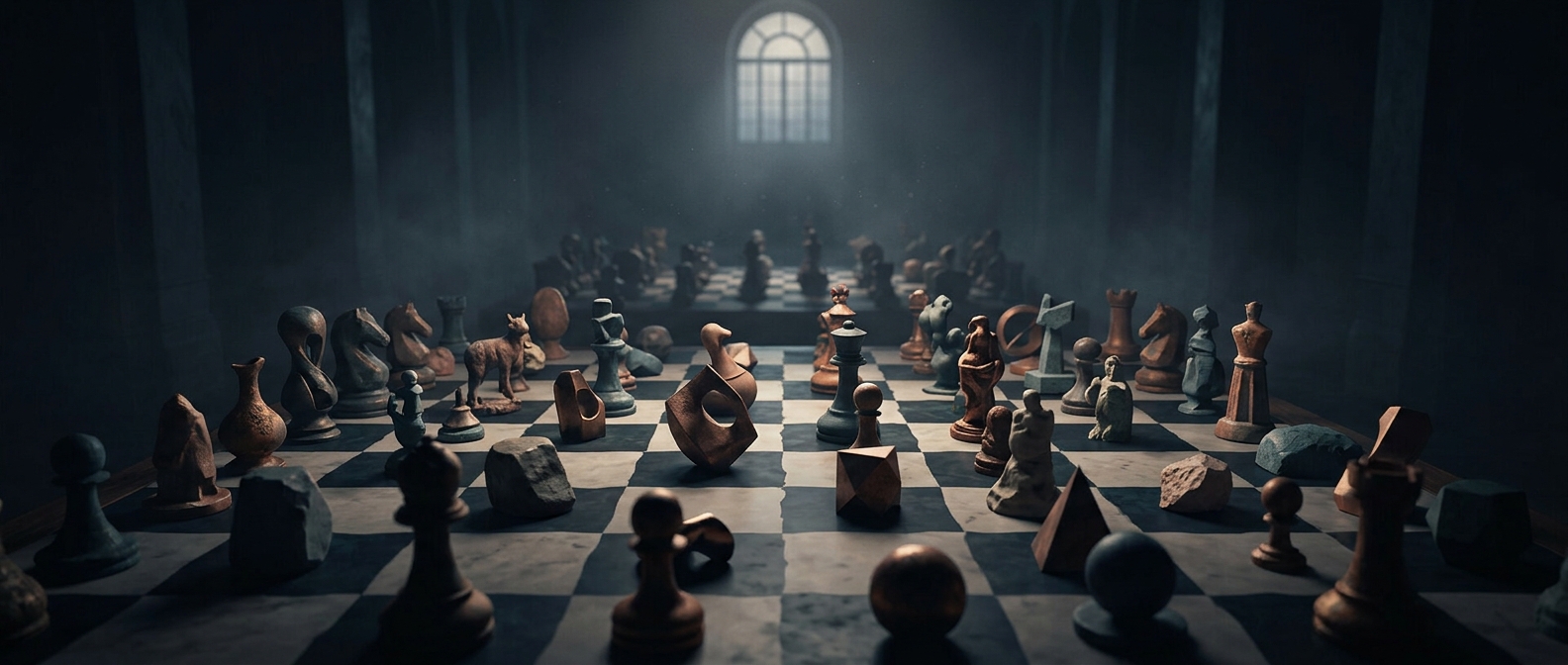
The obstacle is combinatorial explosion. At almost every turn, a player can choose among many legal moves; each choice creates a new position with its own possible replies. The resulting “game tree” branches outward, and its length is not fixed: games can continue for many moves before they end. Even a machine that examines positions at extraordinary speed cannot simply enumerate the whole tree.
Why clever search is not enough
Chess programs avoid brute force by using strategies such as evaluating positions, searching promising lines more deeply, and cutting off branches that seem unlikely to matter. These methods make engines formidable, but they do not prove that every alternative has been handled correctly. A line dismissed as unpromising could, in principle, contain a move that changes the result.
There are also endgame tablebases: databases that give perfect answers for positions with only a small number of pieces left. They show that exact chess knowledge is possible in limited regions. But the number of possible positions swells enormously when more pieces are on the board, so solving those manageable endings does not solve the opening position.
Strong play is not the same as a proof
Modern engines can play at a level beyond human reach, yet their recommendations are based on searching and evaluating a tiny fraction of all possible continuations. A convincing line, or even a result that appears stable across many searches, is not the same as a mathematical proof of the game’s outcome.
That distinction is the unsettling part: chess can be played extraordinarily well without being solved. The practical limit is not a shortage of cleverness, but the sheer number of futures that would have to be ruled in or out.