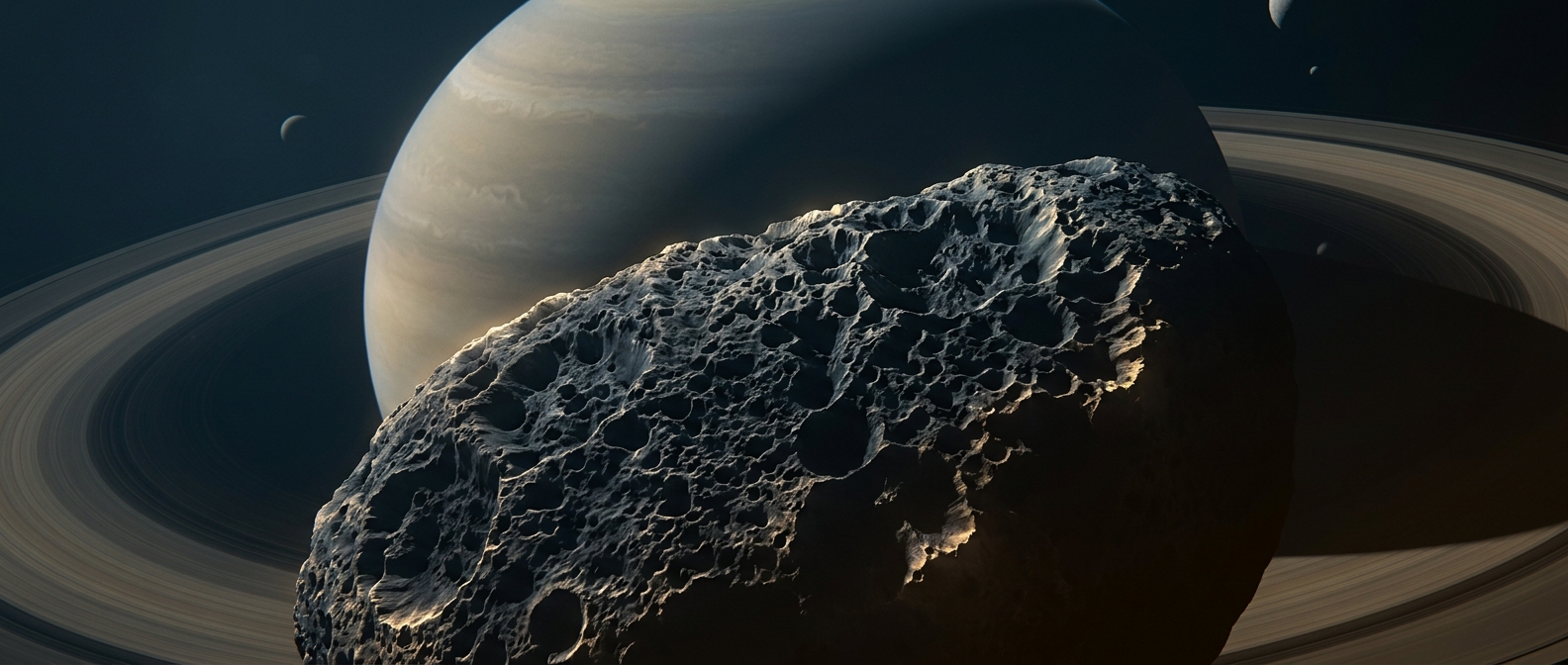
How Storms Could Turn Carbon Into Diamonds
On Jupiter and Saturn, a lightning storm may do more than flash across the clouds. In one proposed pathway, lightning breaks apart methane—a gas containing carbon and hydrogen—and leaves carbon-rich particles behind. As those particles fall into the planets’ dense atmospheres, pressure squeezes them into increasingly compact forms. Far below the visible clouds, conditions may be strong enough for some carbon to crystallize as diamond.
That is the origin of the striking idea of “diamond rain”: not gems forming in the storm clouds, but crystals potentially growing much deeper inside the planets and sinking through layers of gas.
A Journey Through Changing Conditions
The pressure does the crucial work. Carbon particles are first compressed; with further compression, their structure can change into diamond. The process depends on temperature as well as pressure, and both increase with depth inside these giant planets.
That journey may not end with diamonds reaching a solid core. Deeper down, temperatures could become so high that the crystals melt or dissolve into carbon-rich material. The precise path depends on conditions inside the planets, which cannot be sampled directly.
A Powerful Idea, Not a Sighted Downpour
Researchers have explored the possibility using laboratory experiments and models of planetary interiors. The proposed chemistry makes diamond formation plausible, but no spacecraft has watched diamonds fall through Jupiter or Saturn. “Diamond rain” is a vivid description of what may happen under extreme interior conditions—not a forecast of gemstones drifting through the clouds.
The memorable twist is that the same crystals that might form under crushing pressure could be destroyed again farther down, leaving the planets’ deep interiors as the final, unseen part of the story.