When the orchestra reaches for artillery
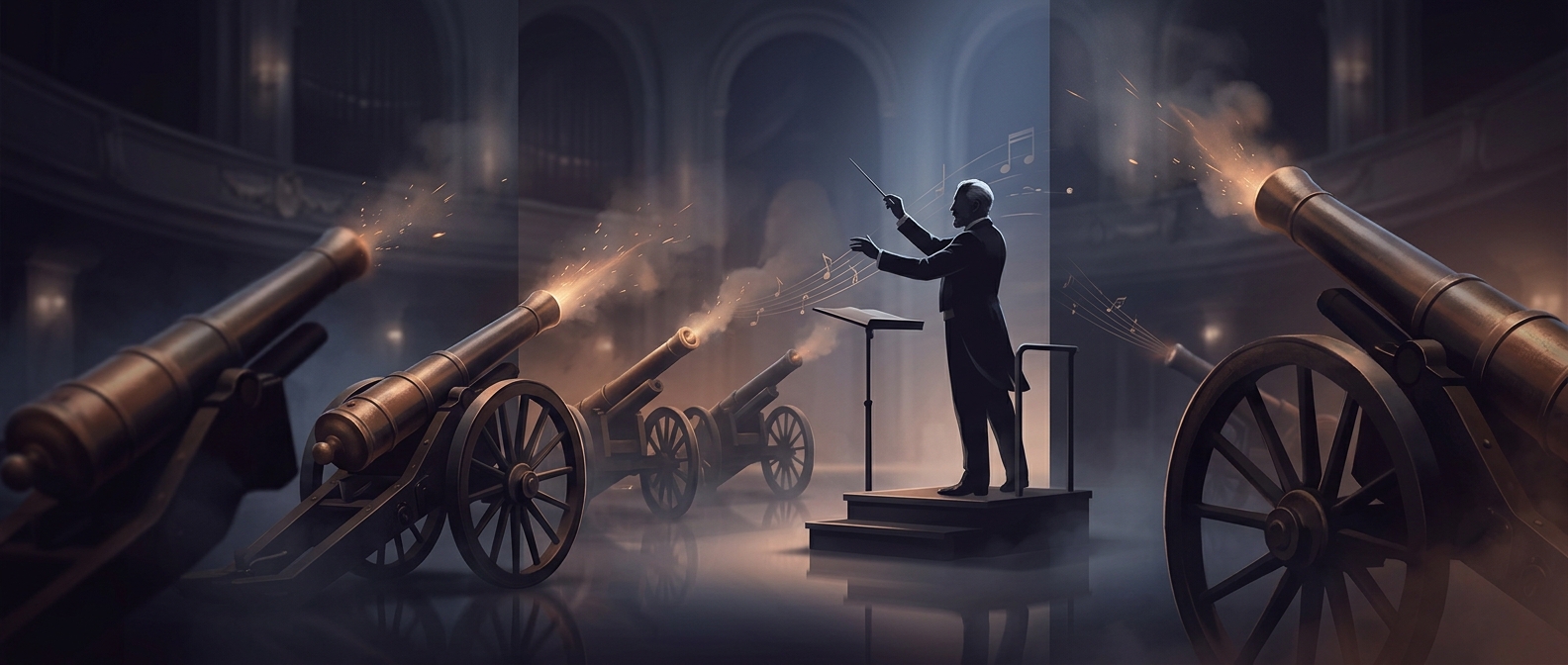
In Tchaikovsky’s 1812 Overture, the cannon blasts are not a later theatrical gimmick: they are part of the score’s finale. They function like percussion on an enormous scale, marking the music’s climactic moments with impacts no ordinary drum can imitate. The piece was written to commemorate Russia’s resistance to Napoleon’s invasion in 1812, so the artillery sound also gives the finale a military character tied to its subject.
Why the sound is hard to reproduce
A cannon is not a conventional instrument that an orchestra can simply bring onstage. Firing one requires a suitable outdoor location, trained operators, safety controls, and coordination with the performance. Its report is also so forceful that an indoor concert hall is generally the wrong place for live artillery.
That leaves conductors and organizers with practical alternatives: use a recording, or create a similar impact with percussion or another substitute. These options can fit more easily into a concert, but they cannot reproduce every quality of a live cannon blast. A recording offers predictable timing; a substitute can be played in the room, but has a different sound and scale.
A musical climax with logistical consequences
The score’s demand makes each performance a small production decision: how to deliver the dramatic punctuation without turning a concert into an artillery operation. When the blasts are recorded or simulated, the music still reaches its intended climax—but the choice of sound reveals how unusual the “instrument” is. In this piece, the orchestra’s loudest punctuation may depend less on a musician’s technique than on what a venue can safely accommodate.