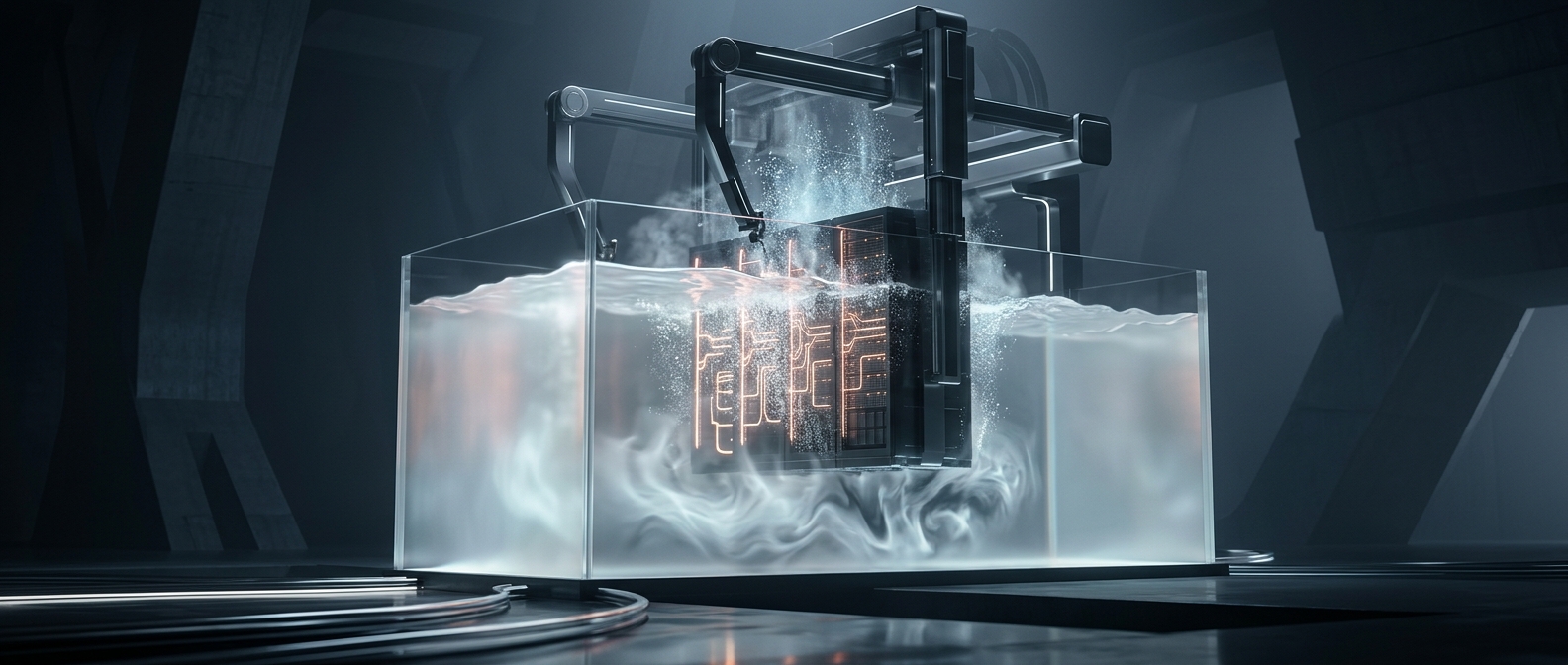
Why a server can safely boil its cooling fluid
The liquid in a two-phase cooling tank is not water. It is an electrically nonconductive fluid chosen to boil at a relatively low temperature, so it can change into vapor while the chips are hot but still operating within their safe range. Because the fluid does not conduct electricity like water does, it can surround exposed electronics without creating the usual short-circuit risk.
That phase change is the key. When a chip transfers heat to the liquid, some of the liquid boils. Turning liquid into vapor takes substantial energy, so the fluid can carry heat away efficiently without needing to be pumped rapidly through tiny channels pressed against each chip.
The cooling cycle happens inside the tank
The vapor rises until it meets cooler coils above the servers. There it gives up its heat, condenses back into liquid, and falls into the tank to be heated again. The fluid circulates through this cycle without being consumed. A facility still has to move the heat onward from the coils, but the tank handles the close-up job of collecting it from the electronics.
This approach can reduce reliance on the fans that push air through conventional servers. That matters in dense computing installations, where moving enough air through tightly packed machines is difficult and itself takes energy. The tradeoff is that the servers, seals, fluid, and tank must all be compatible with immersion; ordinary hardware cannot simply be dropped into any liquid.
The surprising part is not that the servers survive a boil. It is that boiling can be the cooling mechanism: heat turns liquid into vapor, and condensation returns the same fluid for another pass.