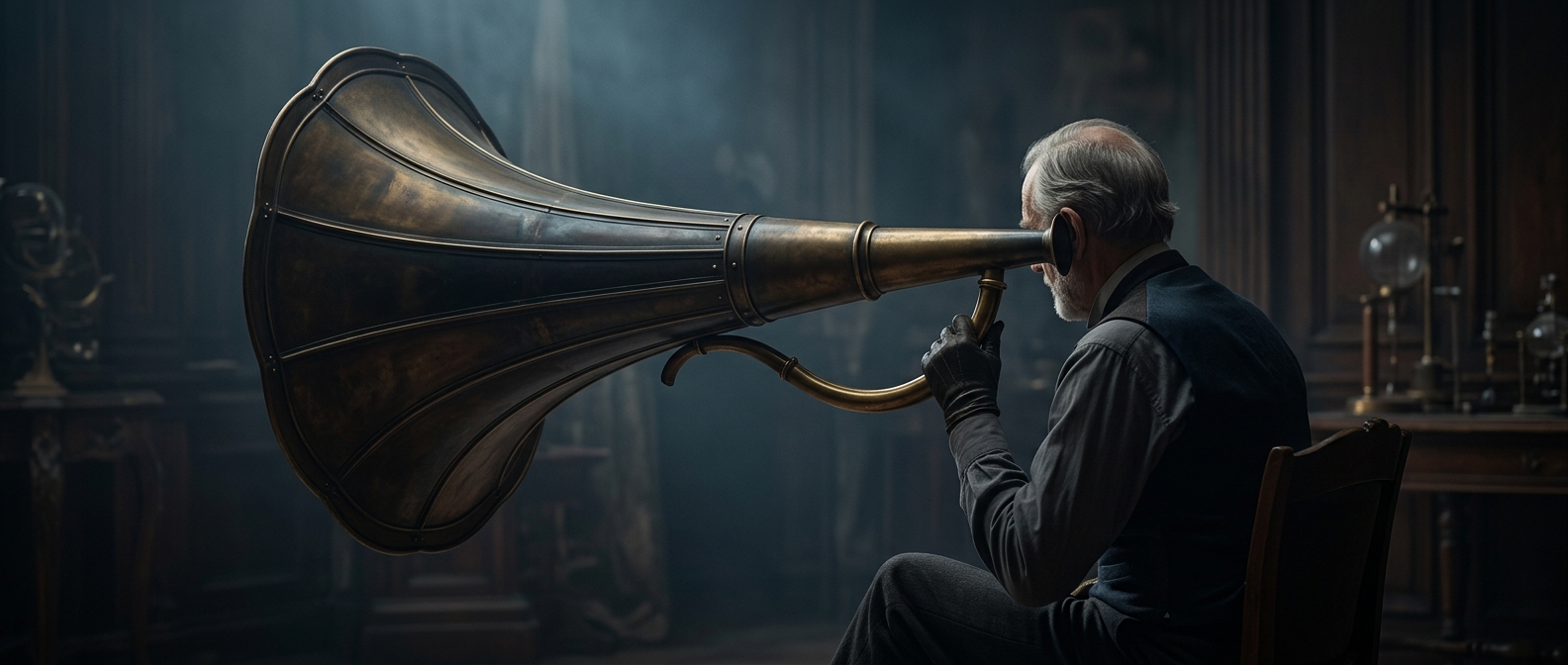
How a brass funnel made sound easier to hear
An ear trumpet worked by collecting sound across its wide opening and guiding it through a narrower passage toward the ear. That could raise the sound pressure reaching the eardrum, much as cupping a hand behind an ear can help catch a distant voice. The device did not create extra energy or electronically boost a signal; it redirected sound that might otherwise have scattered around the listener.
Its shape also affected what the listener heard. A trumpet could make some pitches more prominent than others, so speech might seem louder without becoming perfectly clear. It could help with a nearby conversation, but it could not separate a speaker’s voice from every competing sound in a noisy room.
Better hearing required careful positioning
Because the device had no microphone or circuitry, it could not adjust itself to changing surroundings. The user had to point its broad end toward the speaker and keep the narrow end at the ear. A speaker moving away—or several people talking from different directions—made that simple arrangement less useful.
That tradeoff was visible as well as practical: the sound-gathering opening had to be large enough to collect useful sound, making the aid conspicuous and awkward to carry. Later electronic aids could use a small microphone and amplification, but the ear trumpet’s basic idea was ingenious in its simplicity: give the ear a larger target for sound, then channel what it catches.