How a star packs a Sun’s worth of matter into a city-sized sphere
A neutron star begins with a massive star whose core can no longer support itself against gravity. When the core collapses, atoms are crushed so intensely that electrons are forced into protons, forming neutrons. The result is not a giant atomic nucleus in every detail, but it is matter compressed to a density that has no everyday counterpart.
The collapse leaves an object only about 12 miles across, while much of the core’s mass remains. That mismatch—stellar mass in a city-sized volume—is why even a tiny sample would weigh billions of tons on Earth. The teaspoon comparison is a way to make the density imaginable; it does not mean anyone could scoop out and handle the material. Away from the star’s crushing gravity and pressure, it would not remain in the same state.
A rotating magnetic field makes a cosmic beacon
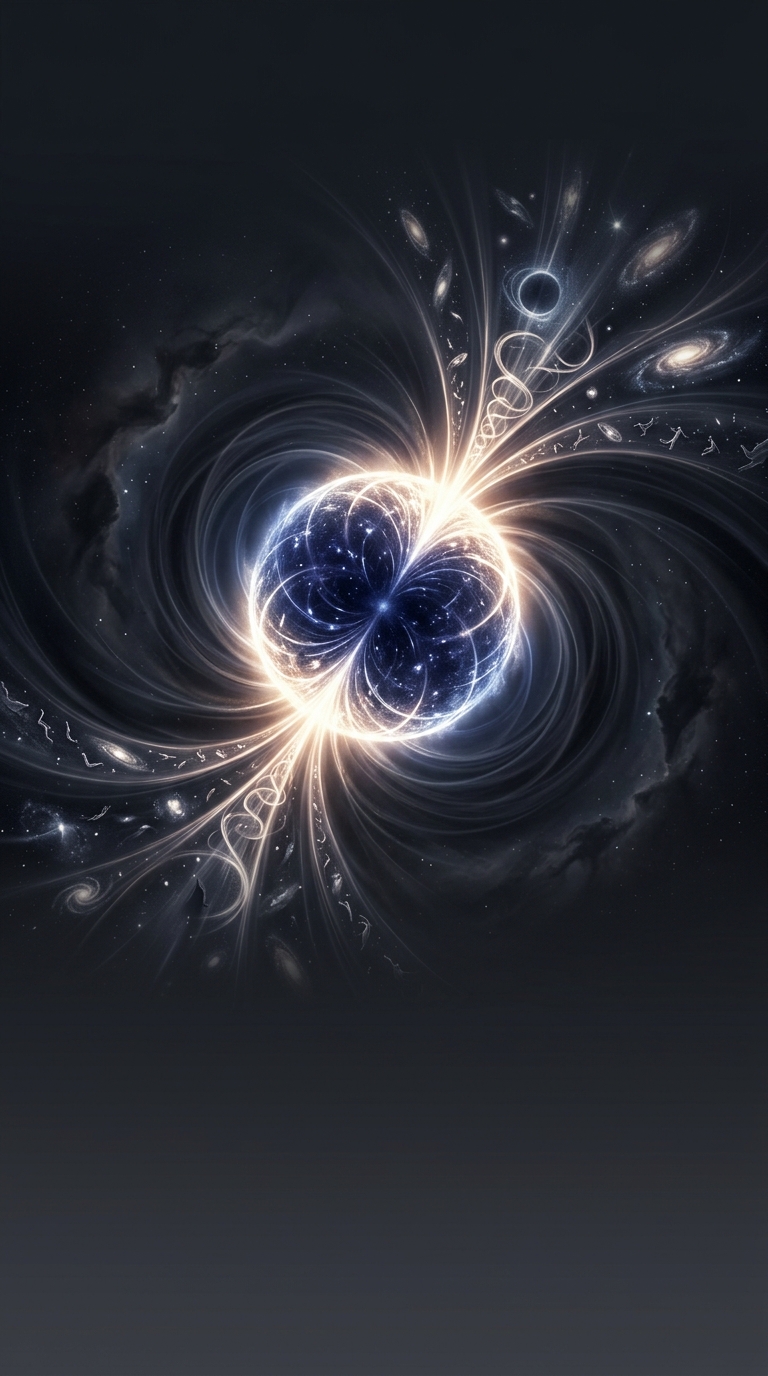
The collapsing core also spins up, much as a figure skater turns faster when pulling in their arms. Its magnetic field can become extraordinarily strong, and charged particles around the star are guided by that field. They produce narrow beams of radiation near the magnetic poles.
The magnetic poles do not necessarily point in the same direction as the star’s rotation axis. As the star spins, its beams sweep across space. If one crosses Earth, telescopes detect a flash; the next sweep produces another. These rapidly repeating signals make the star appear to pulse, which is why such objects are called pulsars.
The pulse is a matter of alignment
A pulsar is not necessarily switching on and off. Its radiation beam is sweeping past us, like a lighthouse beam crossing a shoreline. From another position in space, the same star might show no pulses at all because its beam never points toward that observer.
So the signal tells us both about the star’s extreme rotation and about our viewing angle. A city-sized remnant can keep time across the vastness of space, not by sending a signal in every direction, but by repeatedly turning a narrow beam through our line of sight.