How a loop of string becomes a shared puzzle
A cat’s-cradle figure begins with a simple tool: a loop of string stretched across the fingers. One person makes a pattern; another takes it up and changes it, often producing a new arrangement. The sequence can be learned by watching and doing, with no special equipment or written instructions.
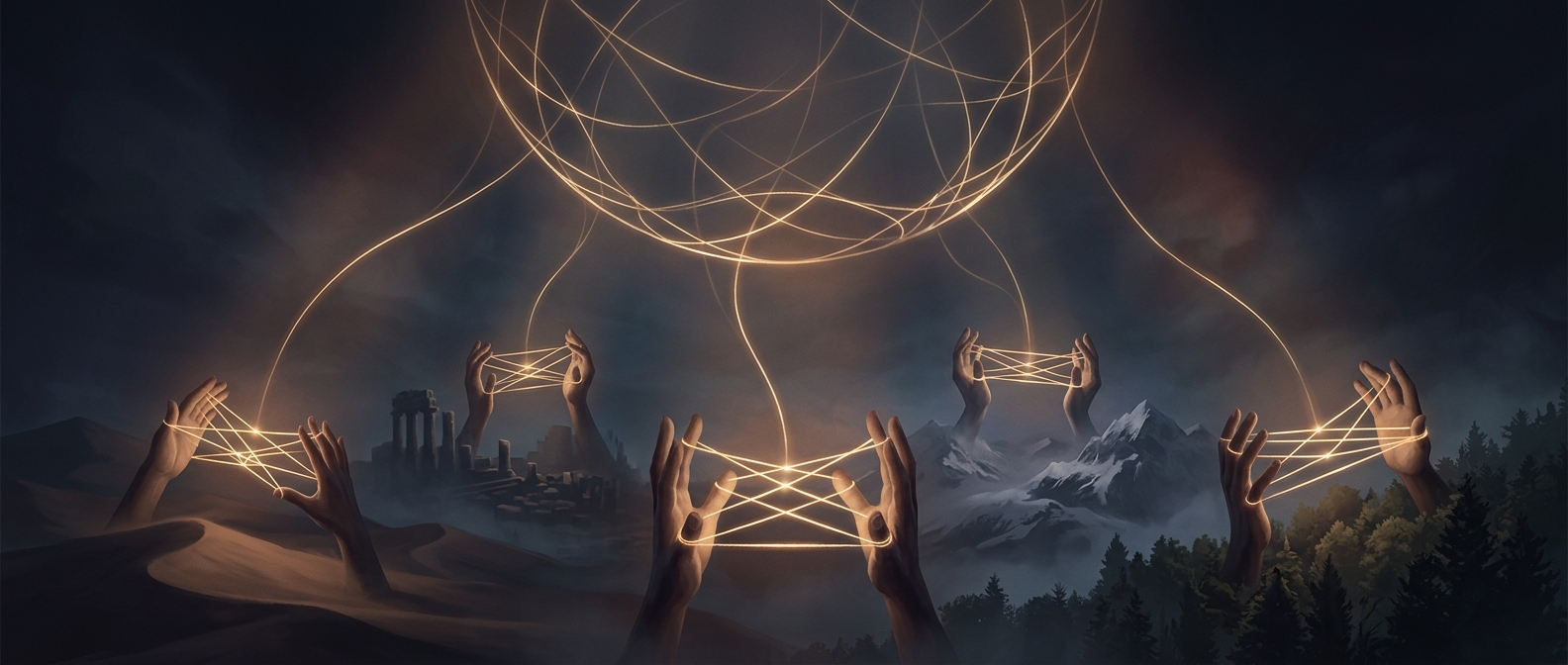
That simplicity helps explain why string figures could arise in many places. String is easy to make or obtain, and hands are universal tools. People who have never met can still discover similar ways to cross, lift, and transfer a loop. In that sense, resemblance does not automatically prove that one community borrowed a game from another.
Similar patterns, uncertain paths
But invention is only one possibility. People, objects, and customs have traveled between communities for a very long time, so a figure could also spread through contact and then be adapted. A pattern’s presence in distant places does not, by itself, reveal whether it was independently invented or passed along—and the two processes could both have played a role.
String figures also belong to particular traditions, not just to a universal pastime. The names, stories, instructions, and ways of performing them can differ from one community to another. Those details may carry more evidence about local meaning and transmission than the final shape alone.
The puzzle is therefore not simply why people everywhere can play with string. It is how to trace the history of particular figures when the same small loop can be reinvented, taught, and transformed—leaving a pattern that looks familiar while its route remains unknown.