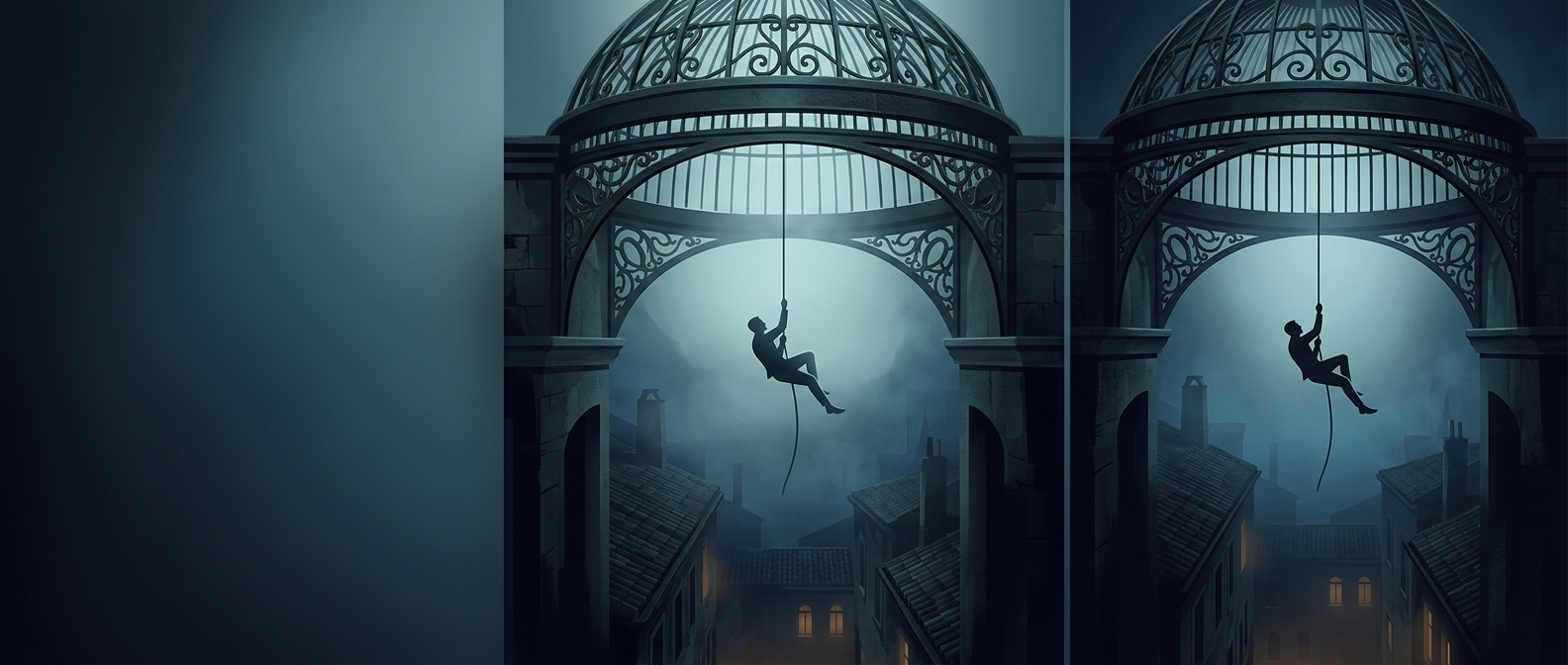
A prison beneath the palace roof
The Piombi took their name from the lead sheets covering the roof of Venice’s Doge’s Palace. Their cells occupied the space just below it: a place where the roof itself was part of the prison’s design. The setting made Casanova’s route unusual. Rather than break through a wall or overpower a guard, he tried to pass from a cramped cell into the palace above.
Turning a Bible into cover
An iron spike could help pry or chip away at a ceiling, but carrying one openly would invite a search. Concealing it inside a hollowed-out Bible made the tool harder to spot. The plan depended on patience: the ceiling had to be opened without drawing attention, and the opening had to become large enough to climb through.
Once out, Casanova still faced the palace roof, not freedom. He had to cross it at night and find a way down into the building. From there, the grand staircase offered a route to the palace’s public entrances—and toward the waterfront, where a gondola could carry him away.
The palace became the escape route
The plan worked by exploiting a gap between two kinds of security. The Piombi guarded prisoners in their cells; the palace’s roof and interior were not necessarily watched as though someone might emerge from above. Casanova’s escape turned the prison’s location inside the palace into an alternative exit. The Bible hid the tool, the roof provided a passage, and the staircase connected that passage to the city beyond.