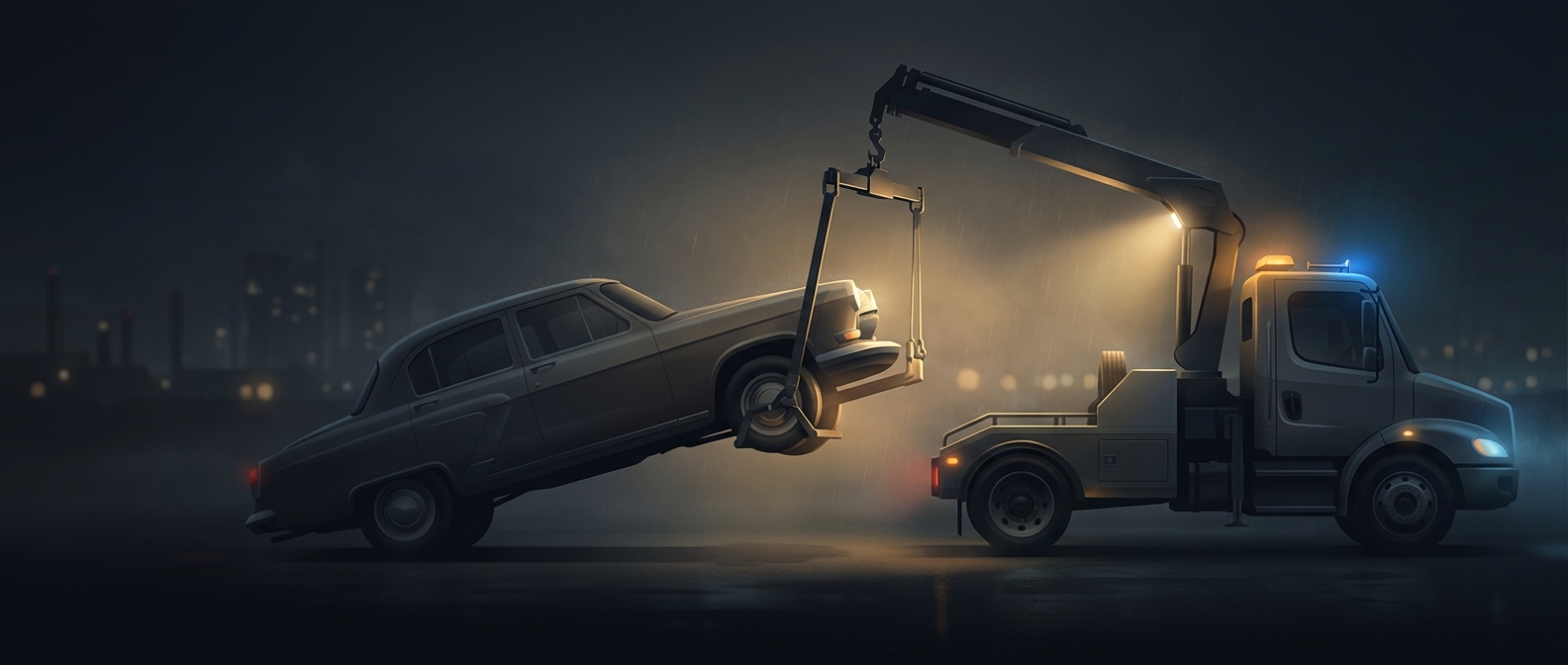
A grip built around the wheel
A wheel-lift uses a metal crossbar and two short forks, often called a yoke. The operator positions the forks so they cradle the tires at one end of the car, then raises the bar with the truck’s hydraulic system. Straps or restraints keep the wheels from shifting as the car is pulled along.
The load travels from the tire through the wheel and hub into the vehicle’s suspension. That gives the tow truck a sturdy, low-mounted point to support, rather than requiring it to hook onto a bumper or reach under the body. Those surfaces may be fragile, oddly shaped, or too close to the ground for a safe attachment.
Why lift only two wheels?
The other pair stays on the road and rolls behind the truck. This makes a wheel-lift quicker to position than a flatbed, which must be lowered and then loaded with the entire car. But the method is not right for every vehicle or situation: the operator has to account for ground clearance, where the car can be safely lifted, and whether towing with two wheels rolling could harm its drivetrain—the parts that deliver power to the wheels.
The design’s useful compromise is simple: support the car at its wheels while leaving much of its body untouched. That is why a tow truck can move a disabled car without needing to find a strong-looking place on its bumper.