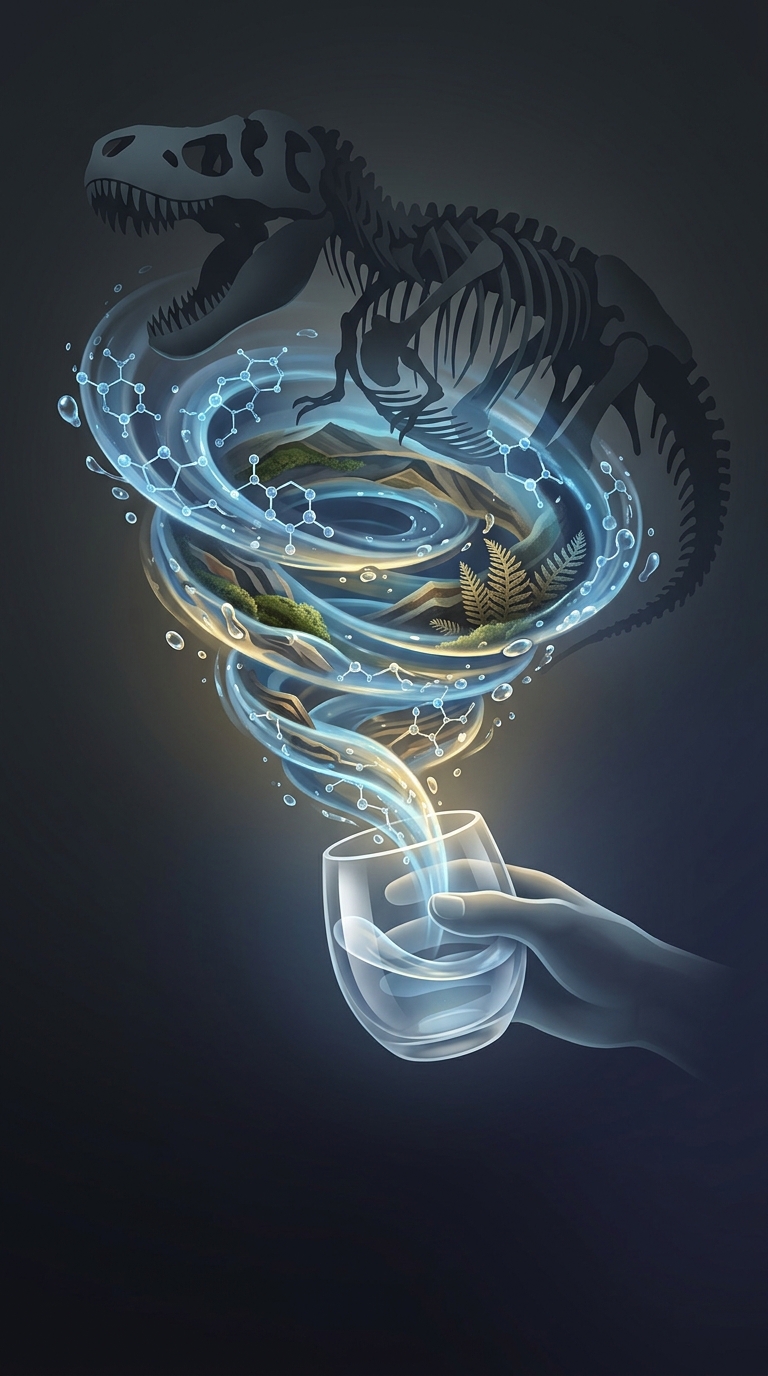
How a Dinosaur’s Water Can Reach Your Glass
Water does not stay in one place for long. Sunlight lifts it from oceans, lakes, and soil as vapor; it falls again as rain or snow, flows through rivers, and eventually returns to the sea. Plants and animals take water in, then release it through breathing, waste, or decay. These routes continually mix water across the planet.
Dinosaurs were mostly water, too. Water molecules entered their bodies when they drank or ate, and later returned to the environment. Over immense spans of time, those molecules could travel through air, streams, and oceans before ending up in modern water supplies.
Why One Old Molecule Is Plausible
A glass contains an immense number of molecules. Even if only a tiny fraction of Earth’s water molecules passed through dinosaurs, broad mixing makes it statistically plausible that a glass contains some of them. The odds are not a guarantee for every particular sip, and water does not circulate evenly or instantly. But the claim is about probability across a vast, well-mixed planetary supply—not about a dinosaur’s water arriving intact in your tap.
The molecules themselves are not marked by their history. A water molecule that once passed through an animal is chemically the same as one that spent its past in a cloud or ocean. What makes the idea striking is the journey: water in a present-day glass may include molecules that have been moving through Earth’s changing environments since long before humans existed.