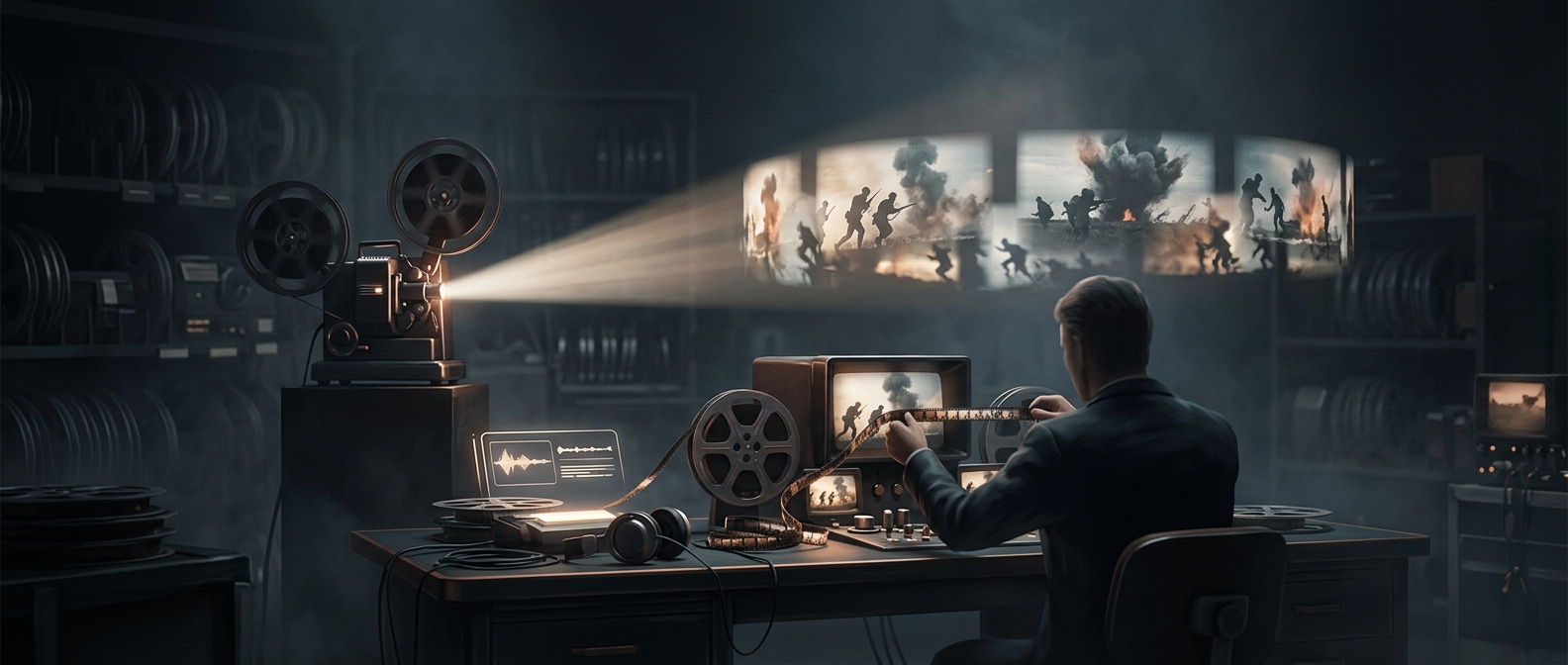
Why One Explosion Can Stand In for Many Wars
A documentary needs more than a dramatic image: it needs footage that can be identified, dated, and legally cleared. A clip of a particular battle may be rare, poorly catalogued, or controlled by an archive that charges for its use. Even when filmmakers find it, the rights may cover only certain uses or territories. By contrast, a shot of a distant blast with no recognizable landmarks or uniforms can be easier to reuse as general visual texture.
That makes the editing choice partly a problem of matching evidence to narration. If a sequence explains a specific battle, the images should ideally show that place and event. If the narration describes warfare more broadly, an indistinct explosion may serve as an illustration—provided the film does not lead viewers to mistake it for proof of the event being discussed.
The Image Can Outlive Its Original Context
Footage is often separated from its original caption, news report, or archive record as it moves between collections and productions. Editors may recognize a clip as usable without knowing every detail of where it came from. A brief shot can then appear in different documentaries, sometimes with different narration and without enough screen time for viewers to spot the reuse.
That creates a quiet tradeoff: generic footage can make a film vivid while also blurring the line between a documented moment and a visual stand-in. The most revealing clues may be small—a landscape, a vehicle, or a uniform that does not fit the war named in the voice-over. When those details are absent, the image feels universal, even though it records one particular event.