A wager decided by the remainder
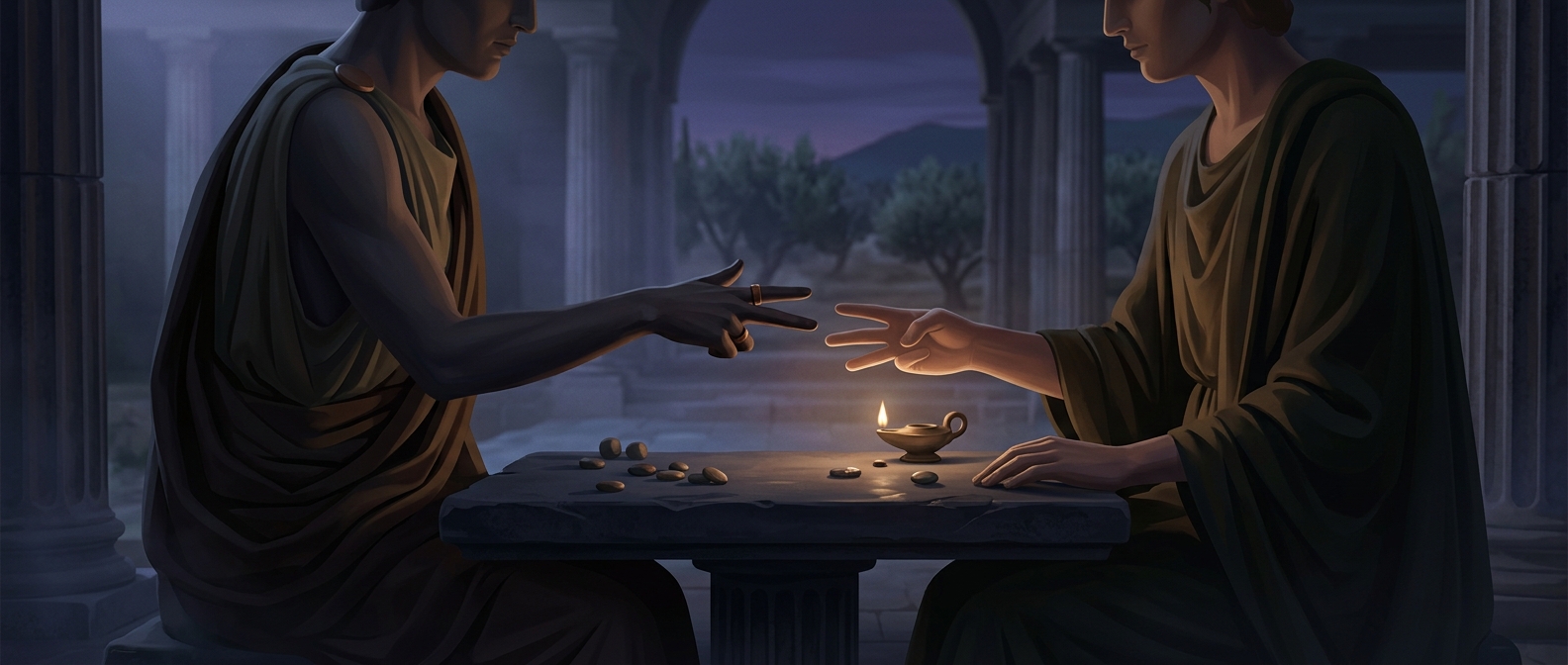
In artiasmos, the decisive question was not how many fingers appeared, but whether their combined count was divisible by two. A total such as four was even; a total such as five was odd. Each player could therefore choose between two outcomes before the fingers were counted.
That simple rule made a hand gesture do double duty: it supplied the number and became part of the wager. Once the players revealed their fingers, adding the counts settled the bet immediately. No board or special equipment was needed, and the same rule worked no matter how large the total was.
A small game of prediction
The uncertainty came from choosing without knowing the other player’s contribution. A player had to commit to “even” or “odd” while the final total still depended on someone else’s fingers. That leaves room for a quick guess—and, in a wager, a reason to try to read or mislead an opponent.
Because only the total’s parity mattered, players did not need to calculate much: they needed to know whether the two contributions had matching parity or different parity. Two even counts, or two odd counts, make an even total; one of each makes an odd total. The whole contest could turn on that tiny distinction.