How the descent turns a pole into a ritual instrument
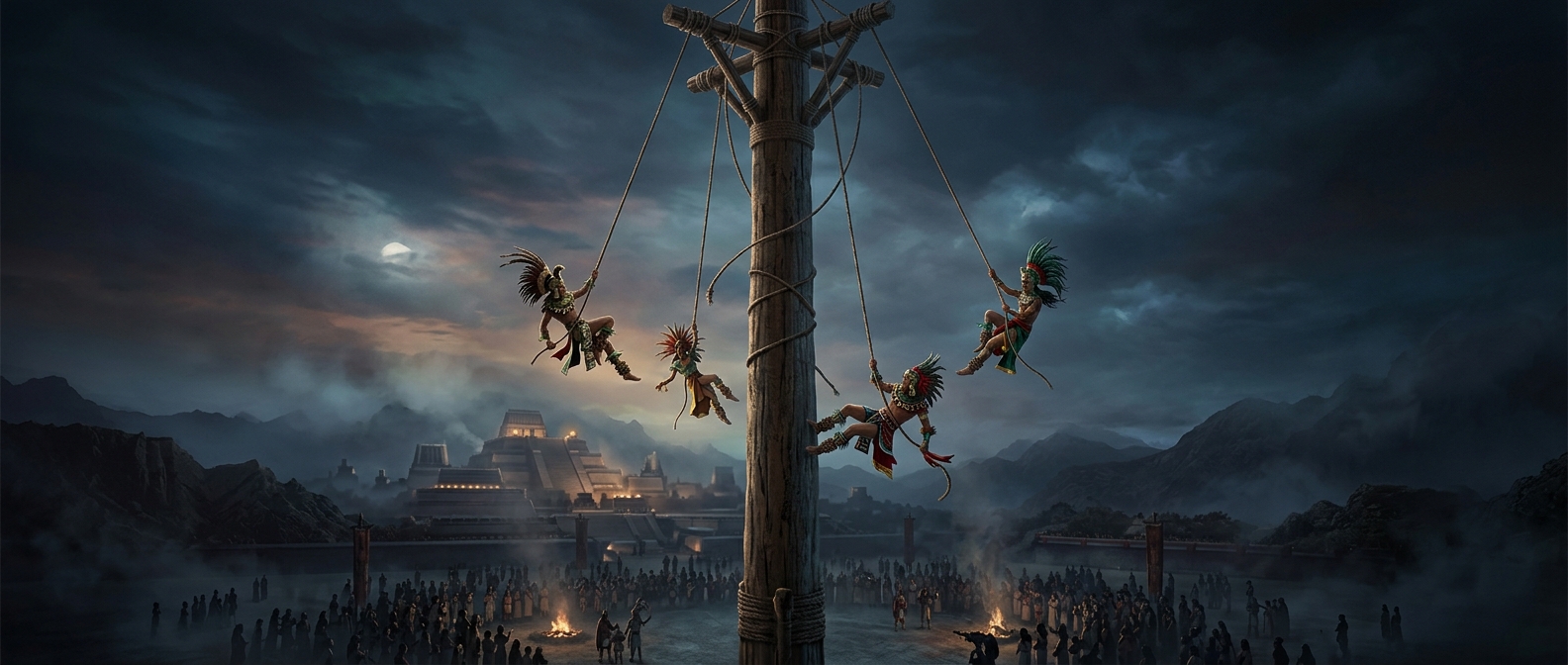
The ropes do more than keep the four flyers attached: they are wound around the pole so that each turn in the air unwinds more rope and lowers the performer. The platform at the top serves as a pivot. As the men spread out and circle it, gravity supplies the motion, while their spacing and posture help keep the descent controlled. The result is a slow spiral rather than a straight drop.
The fifth performer remains on the small platform, moving and playing as it turns. His position makes the music part of the action, not accompaniment from the ground: he has to balance above the descending flyers while the platform rotates beneath him.
A ceremony carried across generations
The Danza de los Voladores is associated especially with the Totonac people of Veracruz, Mexico. Its precise beginnings are not documented well enough to pin the practice to a single origin story. It is understood as an Indigenous ceremony connected with the relationship between people, nature, and the forces that sustain life. The descent’s circling movement gives that idea a visible form: human bodies move through the air in an ordered pattern, accompanied by music.
The performance has endured through major changes in Mexican history, including the spread of Spanish rule and Christianity. Today it is also presented for visitors, but it remains a living tradition rather than merely a stunt. The striking detail is that the spectacle depends on restraint: the flyers do not jump free. Their carefully measured spiral is made possible by a rope system, practiced coordination, and the musician’s balance at the center of the turning platform.