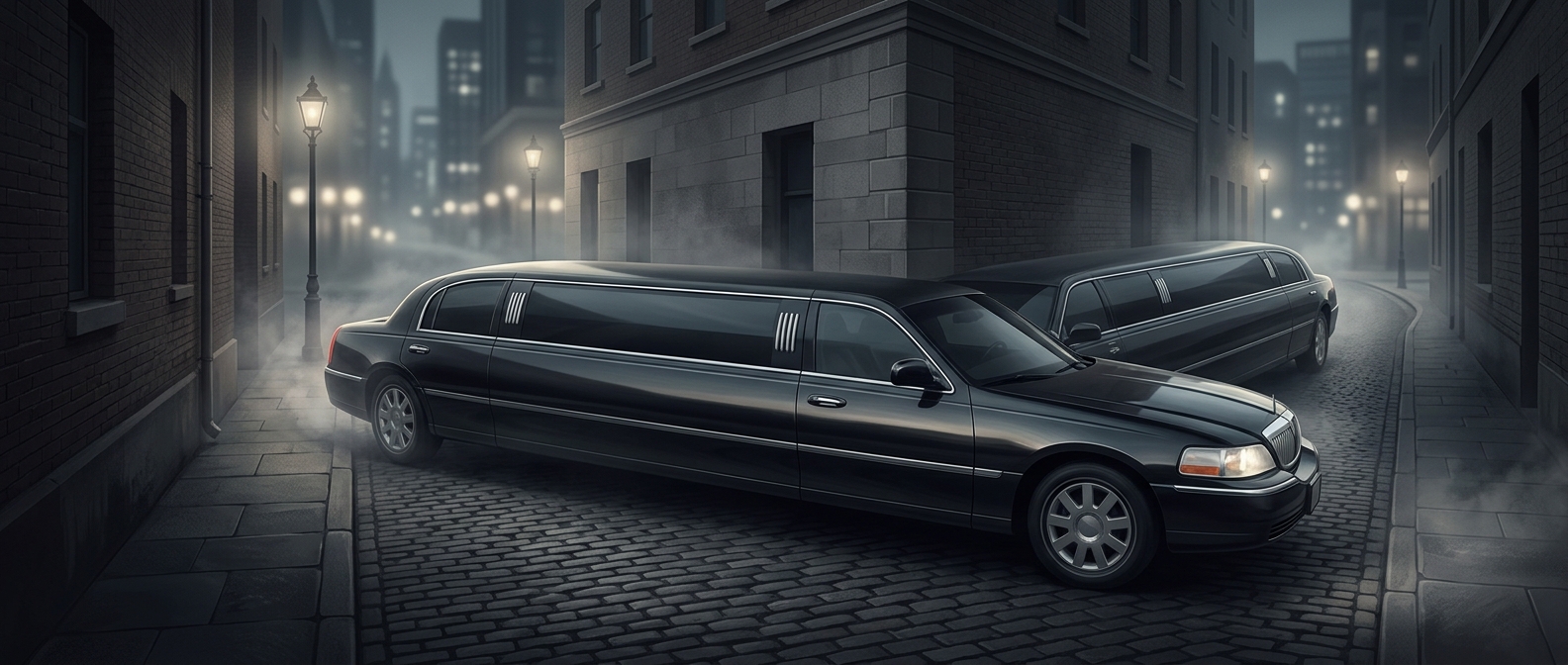
Why a Stretch Limo Cuts the Corner
A limousine’s front wheels choose the turn, but its rear axle does not follow the same curve. As the front swings around a corner, the long body pivots behind it, and the rear wheels trace a tighter arc—often passing closer to the inside curb than the front wheels did. This is called offtracking: the difference between the path of the front and rear wheels.
The longer the distance between the axles, the more pronounced that difference becomes. A stretch limousine can therefore clear a corner with its front end while its rear wheels or lower body still clip the curb. The problem is not simply that the car is wide; it is that its length makes the rear follow a sharply inward path.
Why Drivers Need More Room
To keep the rear wheels off the curb, a driver may need to begin the turn farther out and make a broader arc. That requires open space on the street and at the corner—space a short car may not need. Parked vehicles, narrow lanes, or traffic waiting in the intersection can take away the room the limo needs.
The same geometry explains why a long vehicle can be awkward even at low speed: slowing down gives the driver more control, but it does not change the rear axle’s path. On a tight urban corner, a few extra feet of turning space can determine whether the limousine completes the turn cleanly or leaves its rear wheels at the curb.