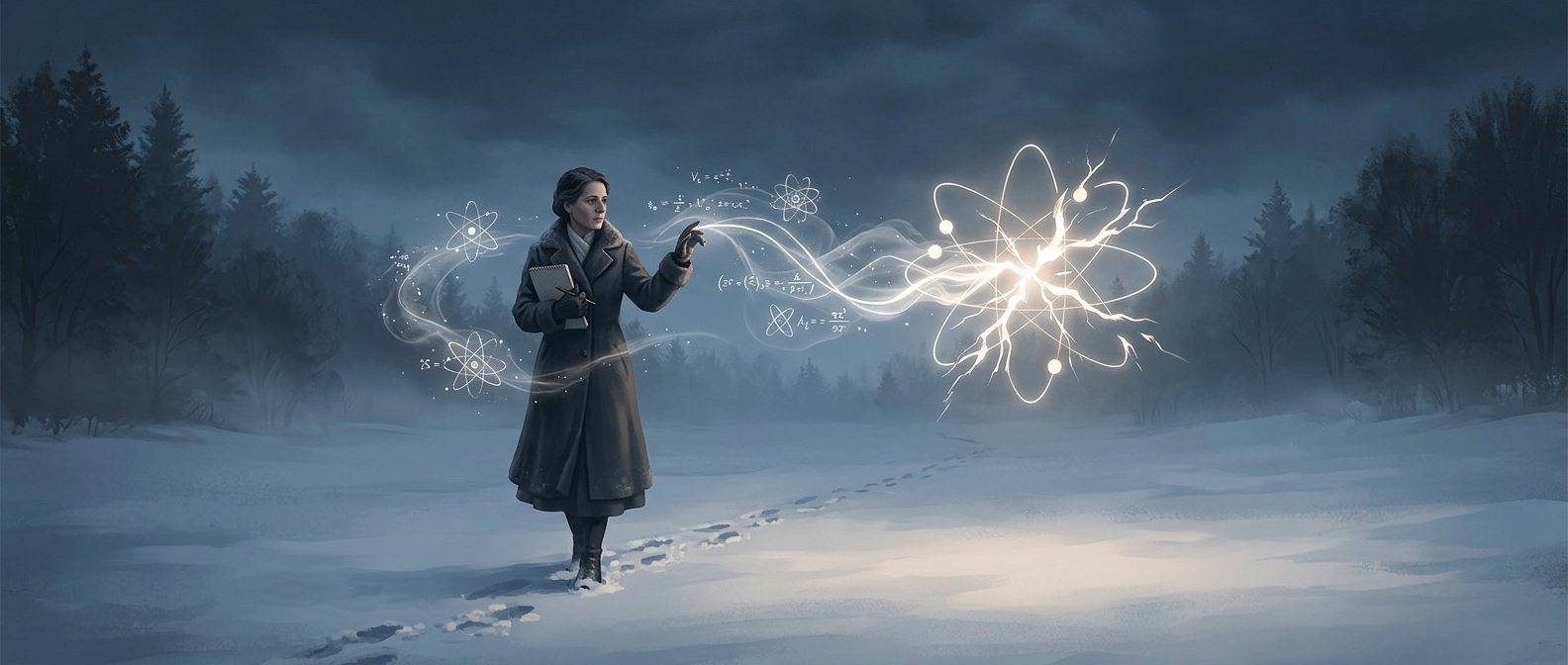
Why a uranium nucleus can come apart
A uranium nucleus is a crowded bundle of positively charged protons and neutral neutrons. The strong nuclear force holds it together at very short distances, while the protons’ electrical repulsion pushes outward. Add a neutron, and the nucleus can become unstable enough to deform and split rather than settle into a lasting arrangement.
The split products are not necessarily equal halves. They are typically medium-sized nuclei, and the rearrangement leaves them, together, with slightly less mass than the uranium nucleus and the neutron that triggered the change. That difference is the mass defect: the energy equivalent of the missing mass, released chiefly as motion of the fragments and other particles.
From one split to a chain reaction
The energetic fragments slam into surrounding material, heating it. A fission event can also release additional neutrons. If enough of those neutrons strike other suitable nuclei before escaping or being absorbed, they trigger further splits; this self-sustaining sequence is a chain reaction. In a reactor, materials and controls regulate the neutron population. In a weapon, an extremely rapid, uncontrolled chain reaction releases energy on a very different timescale.
That consequence made the explanation more than an account of an unusual nuclear event. It showed how a tiny change in nuclear mass could correspond to a large release of energy—and why the number and fate of the freed neutrons mattered as much as the original split.