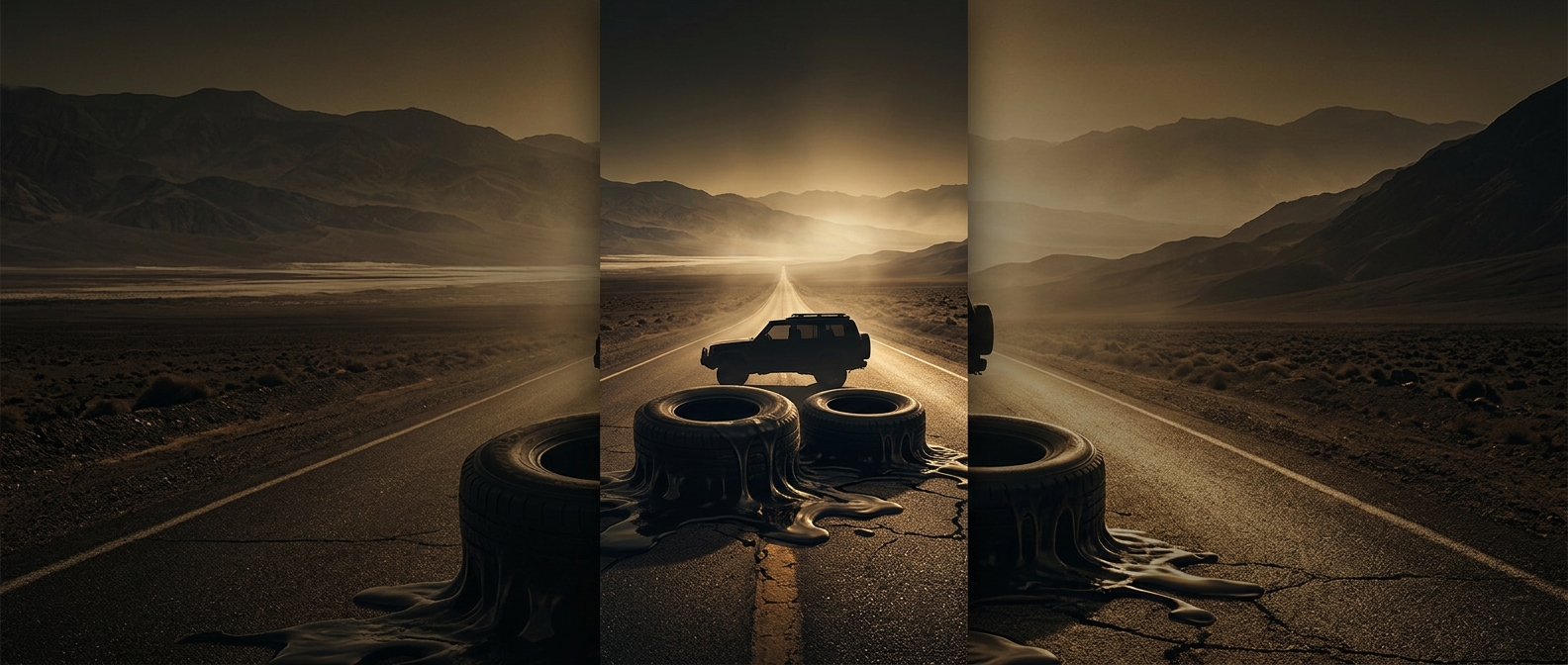
Why Death Valley pavement can feel sticky
Asphalt is not a solid rock: it is a mix of mineral aggregate—crushed stone and sand—held together by bitumen, a tar-like binder. That binder becomes softer as it heats. In Death Valley’s intense summer sun, dark pavement absorbs heat, and the road surface can become hotter than the air around it. When the binder softens, the top layer may feel tacky under tires or become more vulnerable to being pushed out of shape.
Heat changes how the road responds
A tire presses down on a small area of pavement with the vehicle’s weight concentrated through its contact patch. Cool asphalt resists that pressure; softened asphalt can yield more readily. The result is not a road turning into liquid, but a surface that may deform or cling slightly where tires pass—especially when a vehicle is moving slowly or sitting in one place.
That distinction matters: the tires themselves are not melting. The challenge comes from driving over a road surface whose firmness has changed. Gentle acceleration, braking, and steering reduce abrupt forces on the pavement and help keep a vehicle controlled on a tacky surface.
The road is part of the desert heat
In a place known for extreme summer conditions, pavement is exposed to the same relentless sun as the surrounding landscape, but its dark surface can absorb and retain substantial heat. The sticky feel is a small, practical sign of that energy at work: even a familiar road material behaves differently when it gets hot enough.