Why a Metal Rail Needs Wax
A skateboard grind is a controlled slide: the board’s metal trucks—the axles and their hangers—ride along a rail while the rider keeps the board balanced. Bare metal can catch on tiny rough spots, seams, or corrosion. A sudden catch interrupts the slide and can pitch the rider off balance.
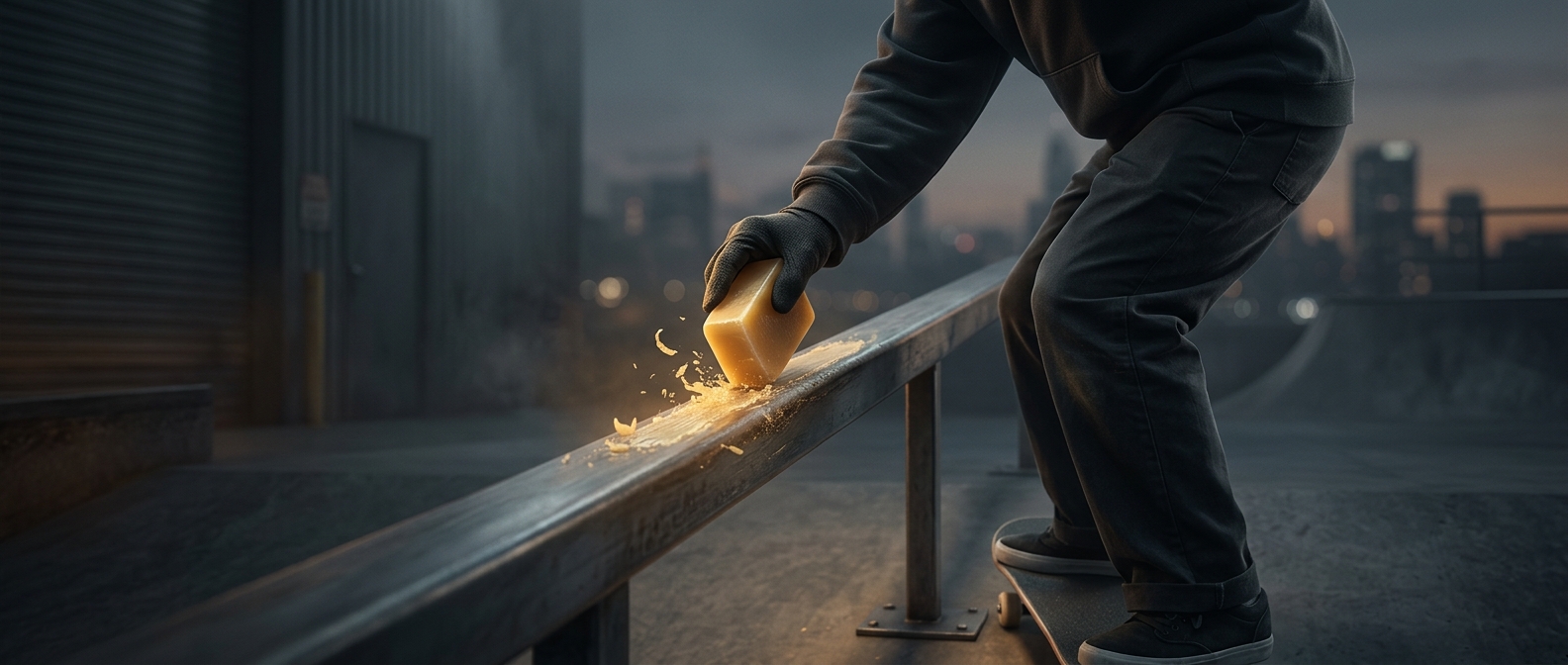
Skateboard wax creates a thin, slippery layer between the trucks and the rail. It also fills some of the surface’s microscopic irregularities, making contact more consistent. The goal is not to change the rail’s shape, but to reduce the resistance that would otherwise make the trucks stutter or stop.
A Small Change With a Tradeoff
Wax is usually rubbed onto the part of the rail where boards are likely to slide. As trucks pass over it, some wax transfers and spreads, so the surface can become slicker with use. Riders may add more where the slide still feels rough; they cannot make a rail uniformly smooth just by coating it once.
That slipperiness is useful on the rail but can be unwanted nearby. Wax that reaches a surface people walk or stand on may make it slick underfoot, and a very slick rail demands control: the board can travel farther than expected. The trick is to make the grind predictable without turning the surrounding spot into a hazard.