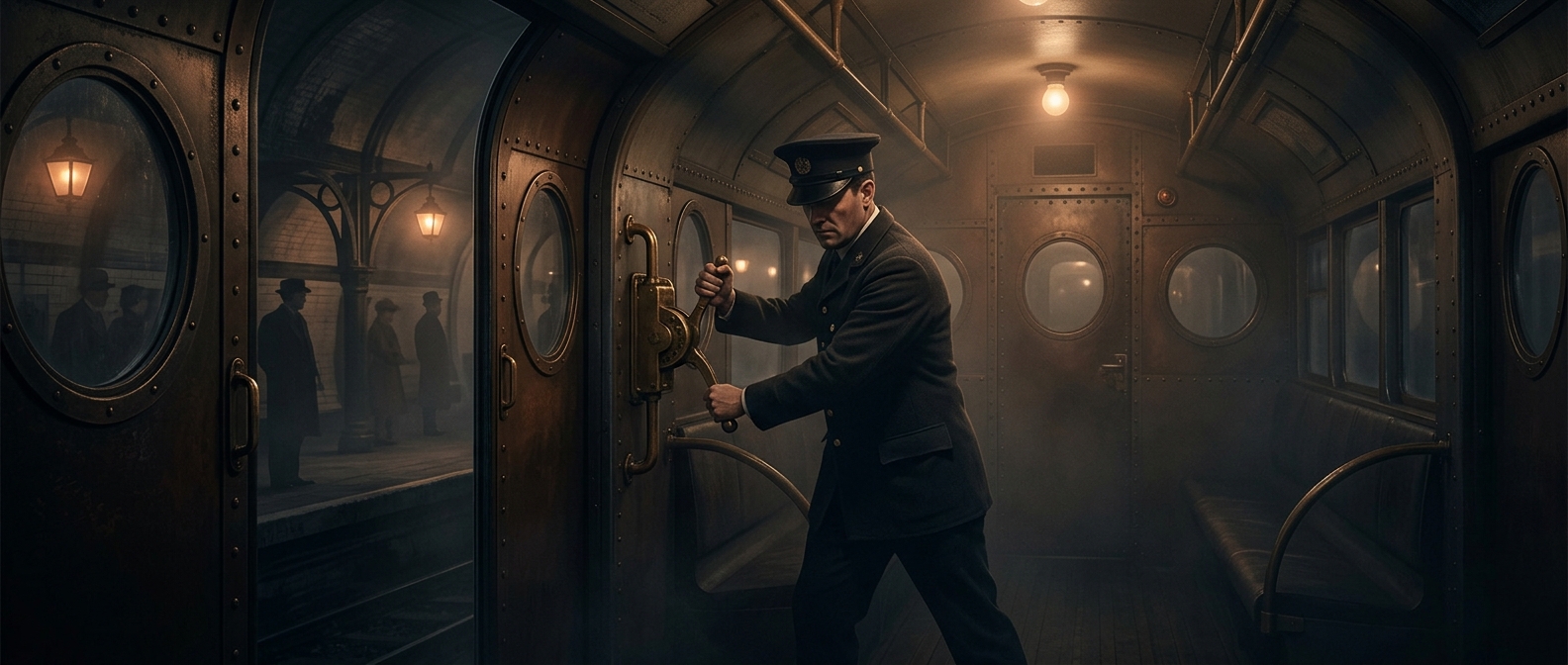
Why Each Carriage Needed Its Own Guard
An early Tube train was not one continuous passenger space. Its carriages were separate compartments, divided by walls with no passageway between them. Once a guard was inside one carriage, there was no way to walk through the train and check the next one.
That made boarding a distributed job. A guard in each carriage could watch its own doors, check that passengers had got on or off safely, and signal that the carriage was ready. The train could depart only after the separate checks were complete. The train’s layout dictated the size of its safety team: every isolated section needed someone responsible for it.
The Trade-Off Built Into the Design
Separate compartments kept passengers in distinct spaces, but they also divided the crew’s view of the train. A guard could not easily spot a problem several carriages away, and the driver could not rely on one person to inspect every doorway. The system therefore depended on each guard checking locally and passing readiness along before departure.
Inter-car corridors changed that arrangement. When passengers and staff could move between connected carriages, the train became easier to treat as a single unit rather than a row of sealed spaces. The old guard-per-carriage setup was not just an extra layer of staffing; it was a practical response to a train whose compartments could not be reached from one another.