A tiny artificial atmosphere
In the 1953 Miller–Urey experiment, water was boiled in a closed glass apparatus so that its vapor circulated through gases chosen to represent the young Earth. Electrodes sent sparks through the mixture; a cooling section then condensed the vapor and let the resulting liquid cycle back through the system. The setup recreated a simple loop of evaporation, storms, and rain—on a laboratory scale.
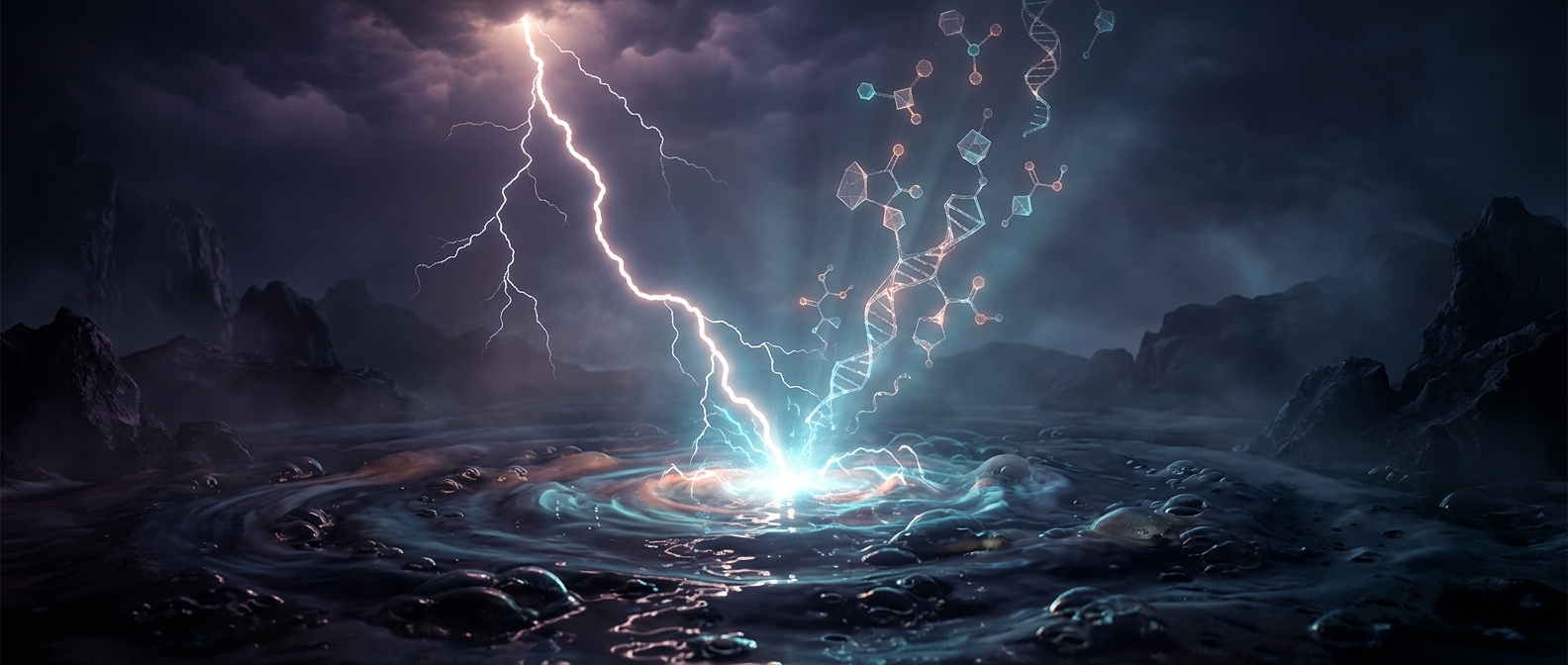
The sparks mattered because they supplied energy to chemical bonds. When molecules in the gas mixture broke apart, their fragments could recombine into new compounds. Some of those compounds included amino acids, small molecules cells use to assemble proteins. The amino acids accumulated in the liquid, where researchers could detect them.
What the sparks did—and did not—show
The key result was not that lightning made life. It was that some ingredients associated with life could arise through ordinary chemistry, without cells or enzymes to make them. The experiment offered a plausible route from simpler chemicals to more complex organic molecules, but it did not explain every step between those molecules and a living organism.
There was also a limit to the model: the gas recipe was strongly suited to producing organic compounds, and it may not have matched the real early atmosphere. If ancient air had a different composition, the same sparks could have produced a different mix or quantity of products. Even so, the apparatus made a powerful point: a storm over a lifeless planet could serve as a chemical energy source, turning simple starting materials into more elaborate ones.