Why a helicopter rotor tilts out of step with its controls
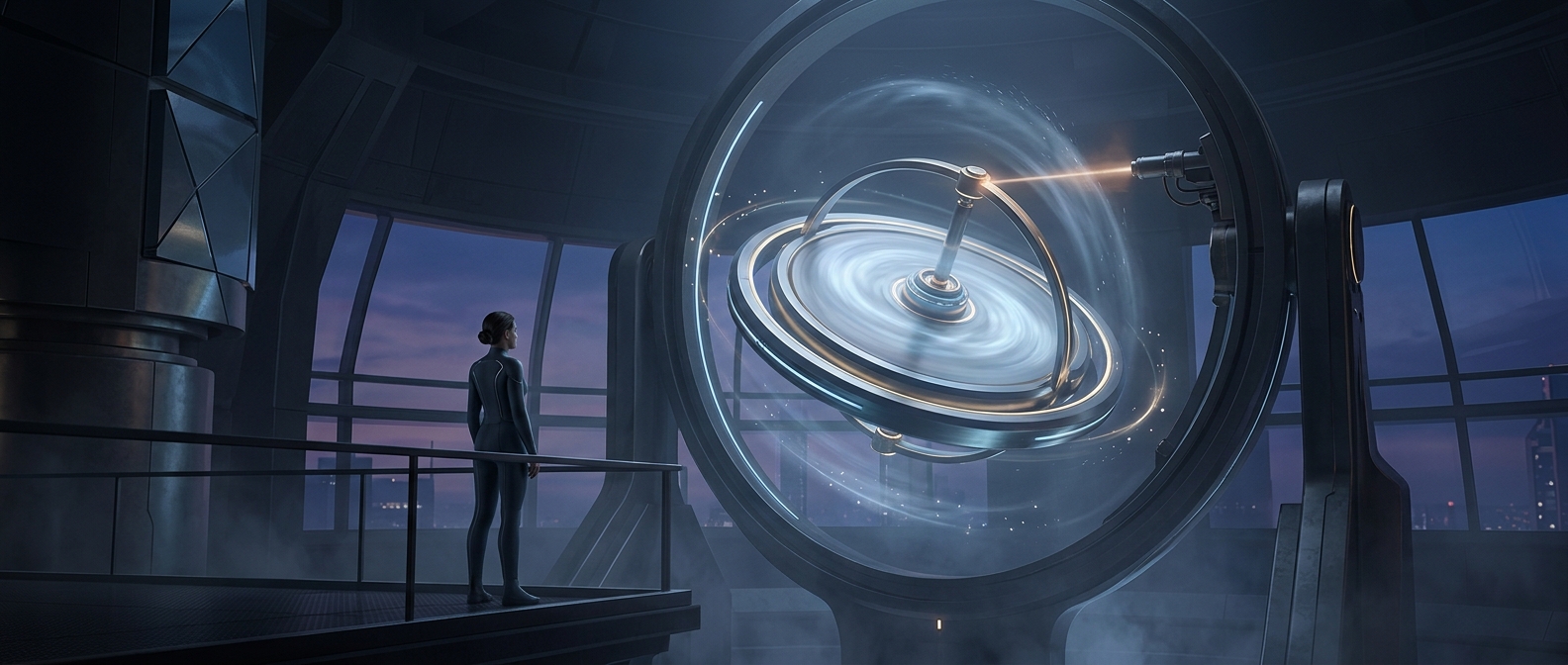
A spinning rotor has angular momentum: its rotation makes it resist changes in the direction of its axis. When a force tries to tilt the rotor, the resulting motion does not line up with the force. Instead, the rotor responds roughly a quarter-turn later in the direction of rotation. This behavior is called gyroscopic precession.
For a helicopter, that delay matters because the rotor is also what pushes the aircraft through the air. To move forward, the pilot must tilt the rotor’s lift slightly forward. But changing a blade’s angle where it is at one point in its circular path affects the rotor’s tilt at a different point. A control that simply raised or lowered the blades in the direction the pilot wanted to move would therefore produce the wrong tilt.
The linkage builds in the correction
In a conventional helicopter, the pilot moves the cyclic control, which changes blade pitch—the angle at which each blade meets the air—as the blades travel around the hub. A mechanism called a swashplate transfers that command to the rotating blades. Its arrangement shifts the pitch changes around the rotor’s rotation so that the resulting change in lift tilts the rotor in the intended direction.
The pilot’s input and the blade’s response are thus deliberately out of phase: the linkage accounts for the rotor’s delayed response. The exact adjustment depends on the rotor’s design and airflow, so the familiar quarter-turn description is a useful principle, not a universal setting.
That correction lets a small cyclic movement steer the rotor’s lift—and therefore the helicopter—without fighting the rotor’s natural tendency to respond at an angle.