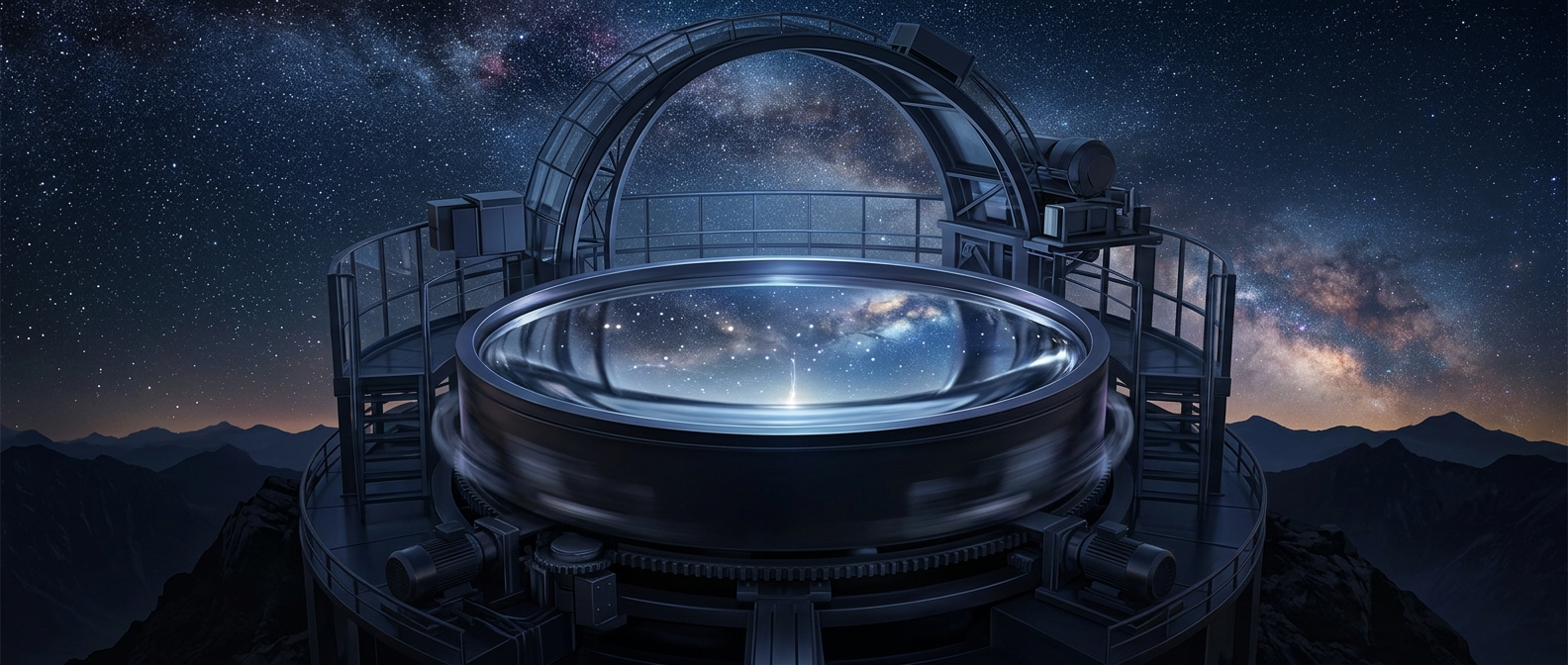
How spinning mercury becomes a mirror
A liquid mirror telescope replaces a carefully shaped glass disk with a shallow pool of liquid mercury. When the pool spins, each part of the liquid is pulled outward while gravity draws it down. The surface settles into a parabola—the same bowl-like curve used in a conventional reflecting telescope to bring incoming parallel light to a focus.
The mirror’s shape is set by its rotation: spin it at a steady rate, and the liquid maintains a predictable curve. Because mercury is reflective, even a thin layer can serve as the optical surface. The container does not need the painstaking grinding and polishing required to give a giant glass mirror that precise shape.
The cost saving comes with a fixed view
A liquid surface can make a large mirror, but it cannot be tilted like a solid one. Tip the vat and the mercury shifts, ruining the curve. So a liquid mirror telescope points straight up and observes the part of the sky passing overhead as Earth turns. It is useful for surveys that can scan a strip of sky, but not for choosing and tracking any target at will.
Mercury also poses a serious poisoning hazard, so the spinning pool must be enclosed and handled with precautions. The design trades flexibility and careful containment for a simpler way to create a very large, accurately curved reflecting surface: instead of shaping a massive piece of glass, the telescope lets gravity and rotation shape the mirror for it.