Why distance makes a game world wobble
A game tracks where things are with numbers: a character might be at coordinates such as (12, 4, 8), while a distant mountain sits at much larger values. Those numbers are usually stored with finite precision, meaning they can represent only a limited number of digits. As coordinates grow, the gaps between representable values grow too. Tiny movements that were distinct near the center can become too small to register cleanly far away.
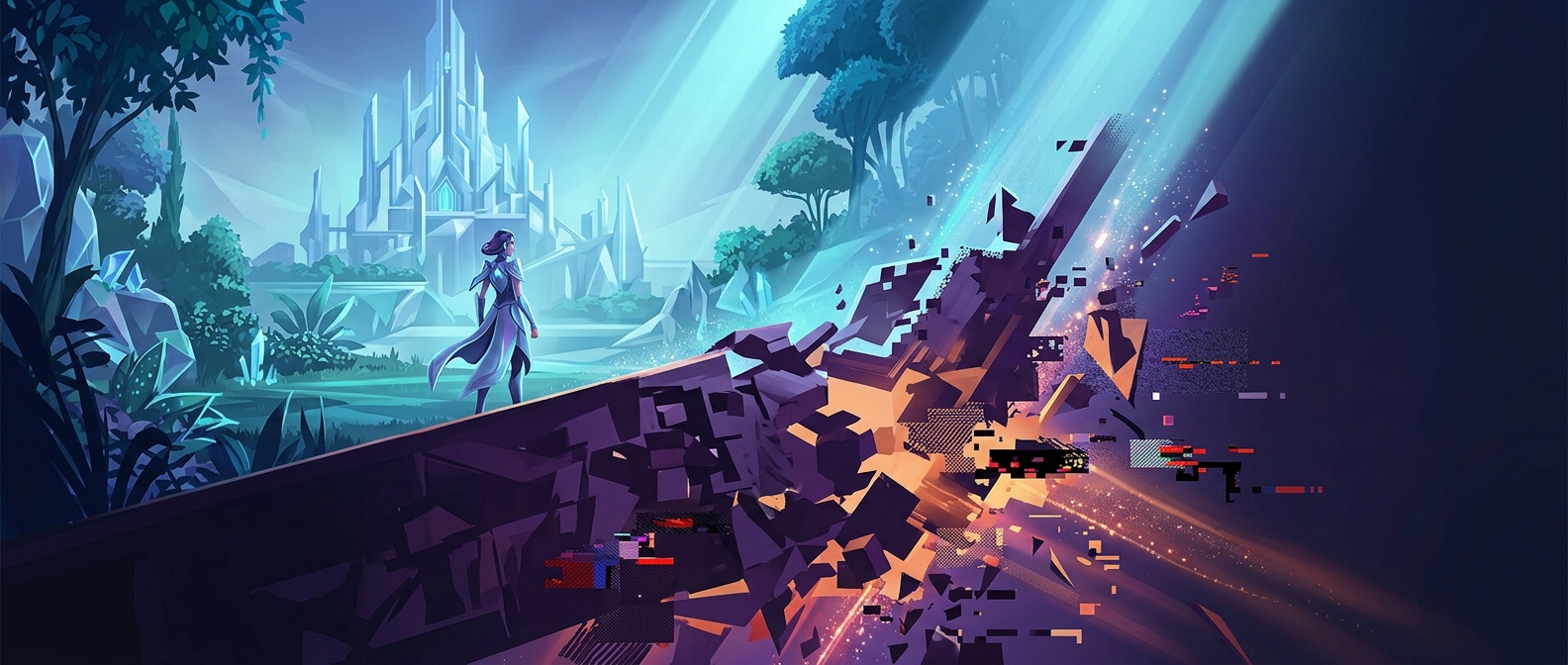
The result is not simply that a character appears slightly misplaced. The game repeatedly updates positions, camera views, and collision calculations. If those calculations round coordinates differently from one update to the next, an object can jitter. A physics simulation may also struggle to decide exactly when objects touch, making collisions or movement look erratic.
How developers keep coordinates manageable
One common approach is to move the coordinate origin—the point treated as zero—closer to the player. The scenery and objects keep their relationships to one another, but the game describes them using smaller numbers. This is called origin rebasing. Another approach is to divide the world into regions and track objects relative to their local region, rather than relying on one enormous set of coordinates.
Using higher-precision numbers can help, too, but it costs more memory or processing than simpler representations, and it does not remove every limit in a large, complex simulation. Developers therefore choose a strategy based on how large the world must be and how much precision its gameplay requires.
The practical consequence is that a seemingly boundless map still needs careful bookkeeping: without it, the far edge can make even a steady character and solid ground appear uncertain.