A wooden guide that turned with the wheels
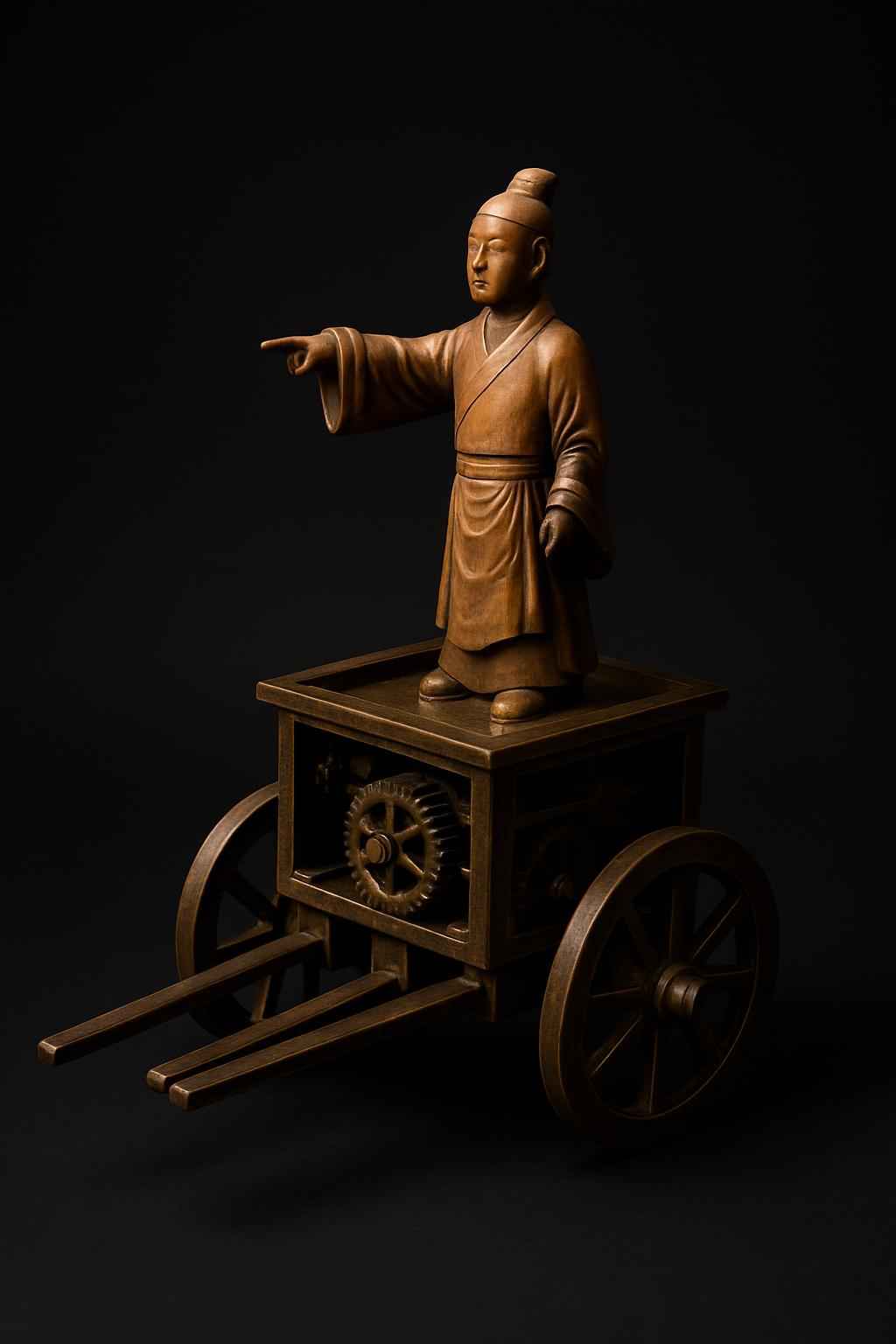
The south-pointing chariot was designed to solve a practical problem: on a broad, featureless plain, a traveler could lose a sense of direction even while moving steadily. Its small wooden figure stood on a cart and pointed in one chosen direction as the vehicle turned.
The key was a set of gears linked to the wheels. When the chariot curved, its two wheels traveled different distances: the outer wheel covered more ground than the inner one. A differential—a gear arrangement that responds to that difference—could use the wheels’ motion to rotate the figure against the cart’s turn. From the traveler’s perspective, the figure stayed aimed along its original bearing.
The limit of a mechanical compass
The device did not sense south the way a magnetic compass does. It had to be pointed south before the journey began; after that, its gears could help preserve that orientation as the cart changed direction. Because the mechanism depended on wheel movement, skidding, rough ground, or faulty alignment could throw it off. It was a directional aid, not an independent source of north or south.
Accounts of the chariot come from ancient Chinese texts, while the workings of particular versions are not fully certain. That makes the idea especially striking: long before a magnetic needle became a familiar guide, Chinese engineers imagined using the predictable geometry of turning wheels to keep a direction in view. On an open plain, a wooden figure could serve as a steady reference—provided the journey began with the chariot correctly aligned.