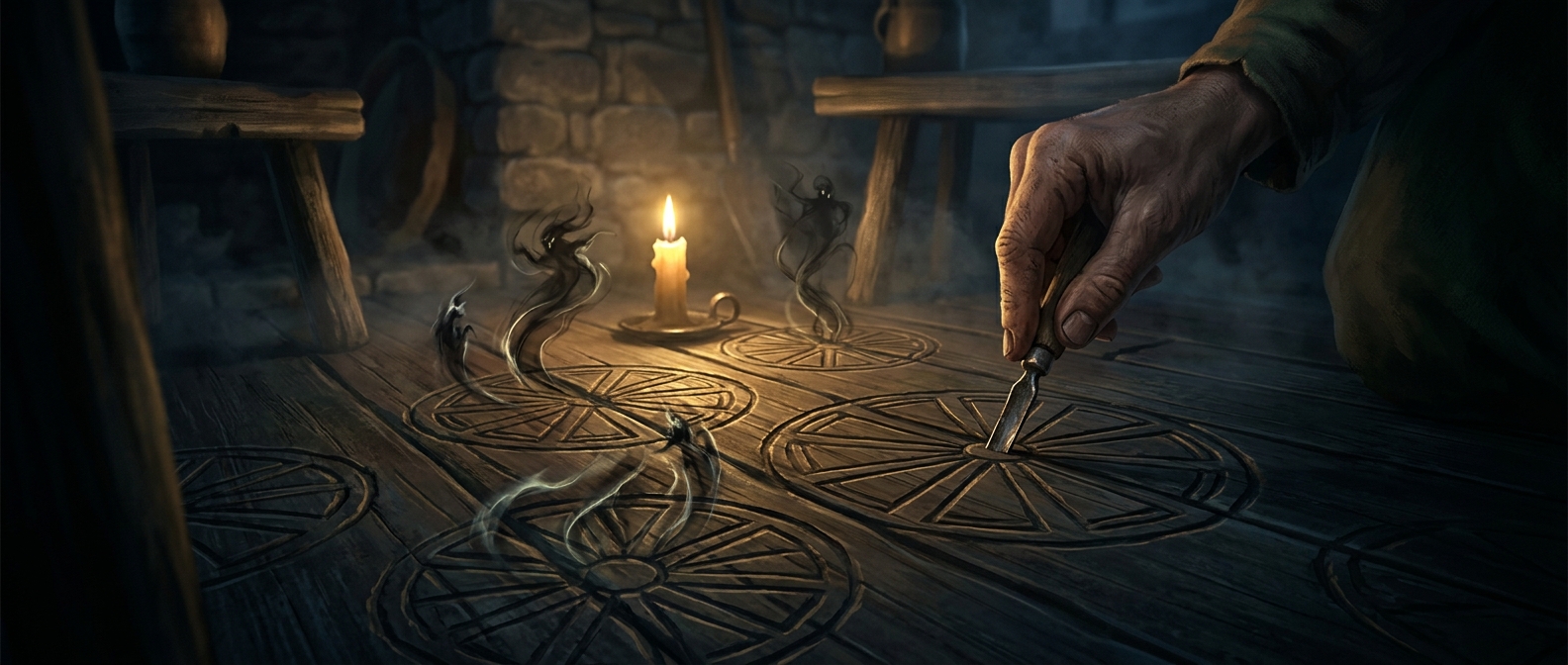
Why a six-petaled wheel guarded a doorway
A daisy wheel is a circular mark made from overlapping arcs, usually forming six petals around a center. In English buildings, people carved these patterns into timber near doors, windows, and fireplaces—places where the boundary between the protected household and the outside world seemed especially exposed.
The mark’s protective logic was visual. A spirit encountering the wheel was thought to be drawn into following its continuous, looping lines, tracing the pattern instead of crossing into the room. The design offered no barrier in the physical sense; its purpose was to occupy or confuse a dangerous presence through repetition.
A pattern made to hold attention
The wheel was practical to create as well as memorable. A series of intersecting arcs could be scratched into a floorboard or beam, leaving a compact design that could be repeated wherever protection was wanted. Its resemblance to a flower may explain the familiar name, but the important feature was the closed, winding path: there was always another curve to follow.
These marks are often called apotropaic, meaning intended to turn away harm. Their placement and form connect them to a broader habit of marking vulnerable parts of a home with protective signs. A carved wheel could remain in the wood long after the belief that gave it purpose had faded, making an ordinary threshold a lasting record of how people imagined danger entering the household.