Why the Bar Changes the Lift
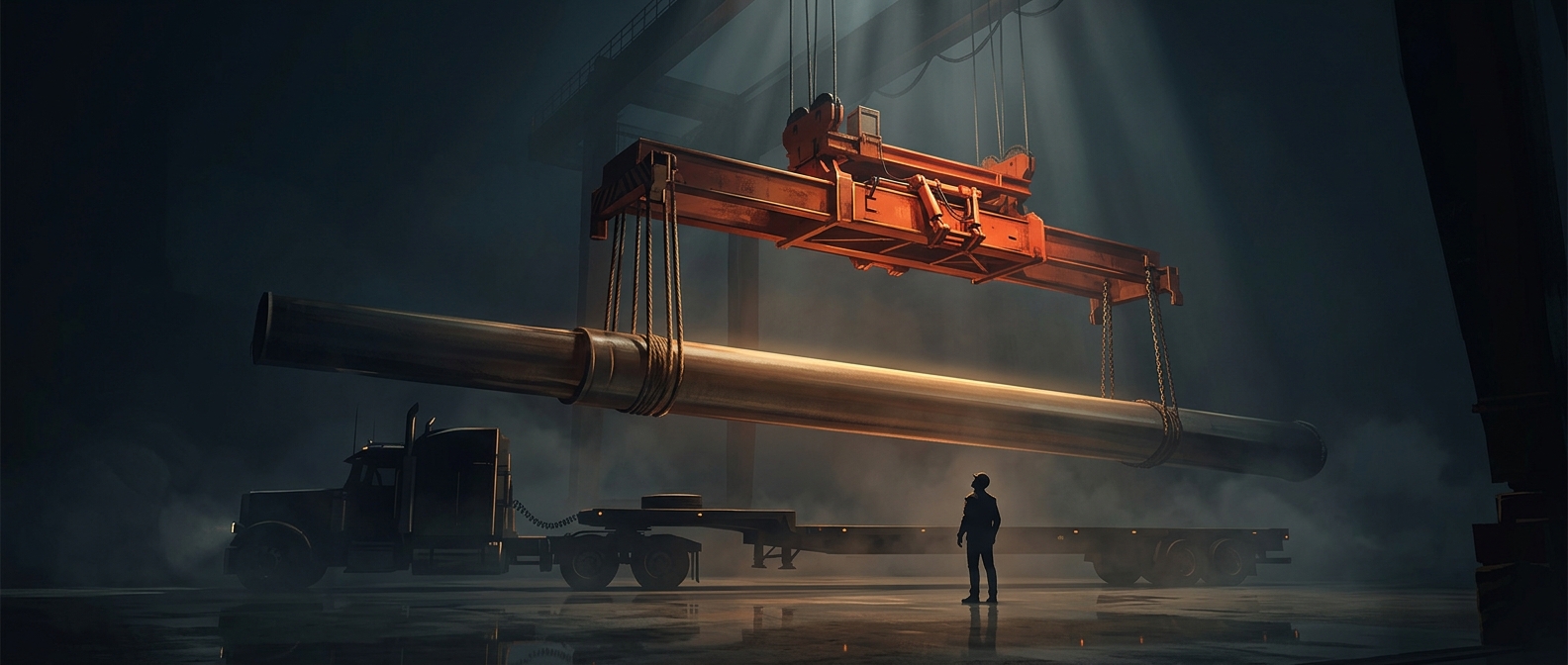
Long cargo—such as a steel beam, pipe bundle, or prefabricated section—can bend or shift if lifting force is concentrated at a few points. A spreader bar creates a wider, controlled gap between the slings attached to the cargo. The bar is suspended from the crane, and the lower slings hang from its ends, placing the cargo’s lifting points farther apart.
That geometry matters. Without a bar, slings running from a single hook to widely spaced points form a steep-sided triangle. As the slings angle inward, their pull has a sideways component that can squeeze the load and increase the force carried by each sling. With the bar in place, the lower slings can remain closer to vertical, reducing that inward pull.
The Bar Carries Force, Too
The bar is not simply a spacer. The lower slings pull its ends inward, putting the bar mainly in compression—a pushing force along its length. The crane’s upper slings pull upward to support the assembly. The bar and its fittings must be designed for those forces, the load’s weight, and the chosen lifting arrangement.
This makes placement important. If the cargo’s center of gravity—the point where its weight effectively balances—is not beneath the lift points, it may tilt as it rises. Rigging plans account for the load’s shape, weight distribution, sling positions, and the bar’s rated capacity; a bar that looks sturdy is not automatically suitable for every lift.
A Lift That Preserves the Load’s Shape
Spreader bars are useful when cargo is long, flexible, or vulnerable to crushing, but they also demand clearance above the load and room for the rigging. The payoff is a lift that supports the cargo across separated points while limiting the slings’ inward squeeze. For a long beam, that can mean the difference between raising it in a controlled position and forcing it to bow or shift during the move.