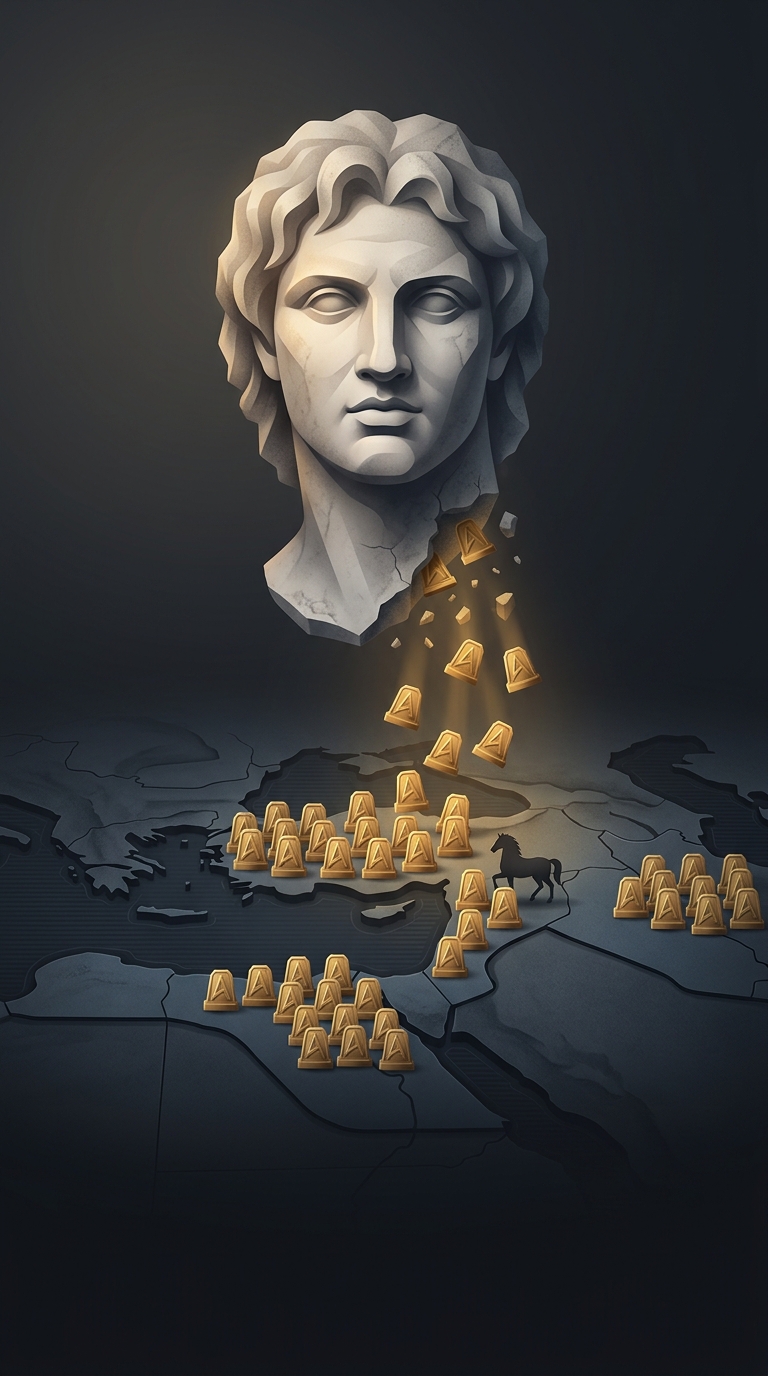
Why Alexander’s Cities Kept His Name
Alexander founded or refounded settlements across his expanding empire, and many bore the name Alexandria. These were not all equivalent to modern, purpose-built cities: some began as military colonies or were reorganized around a garrison, while others grew into lasting urban centers. The familiar claim that he named more than seventy cities after himself is difficult to verify, because ancient accounts and later traditions do not always distinguish a new foundation from a renamed or relocated settlement.
The repeated name served a practical purpose as well as a commemorative one. A settlement could house soldiers and migrants, support control of a strategic region, and connect local trade to the new imperial order. Calling it Alexandria also made the king’s presence legible across great distances: even when Alexander was elsewhere, the city’s name attached his rule to the landscape.
A City for Bucephalus
Bucephala was different. Its name honored Bucephalus, Alexander’s celebrated horse, after the animal died during the campaign in the Indian subcontinent. Ancient tradition places the city near the Hydaspes River, though details of its exact location and founding are uncertain. The gesture turned a personal loss into a public memorial—and gave the horse a place in the map of the empire Alexander was building.
That contrast is worth remembering: the many Alexandrias projected a ruler’s authority, while Bucephala preserved the name of a companion. It also shows how conquest left marks not only through battles, but through the names and settlements that followed them.