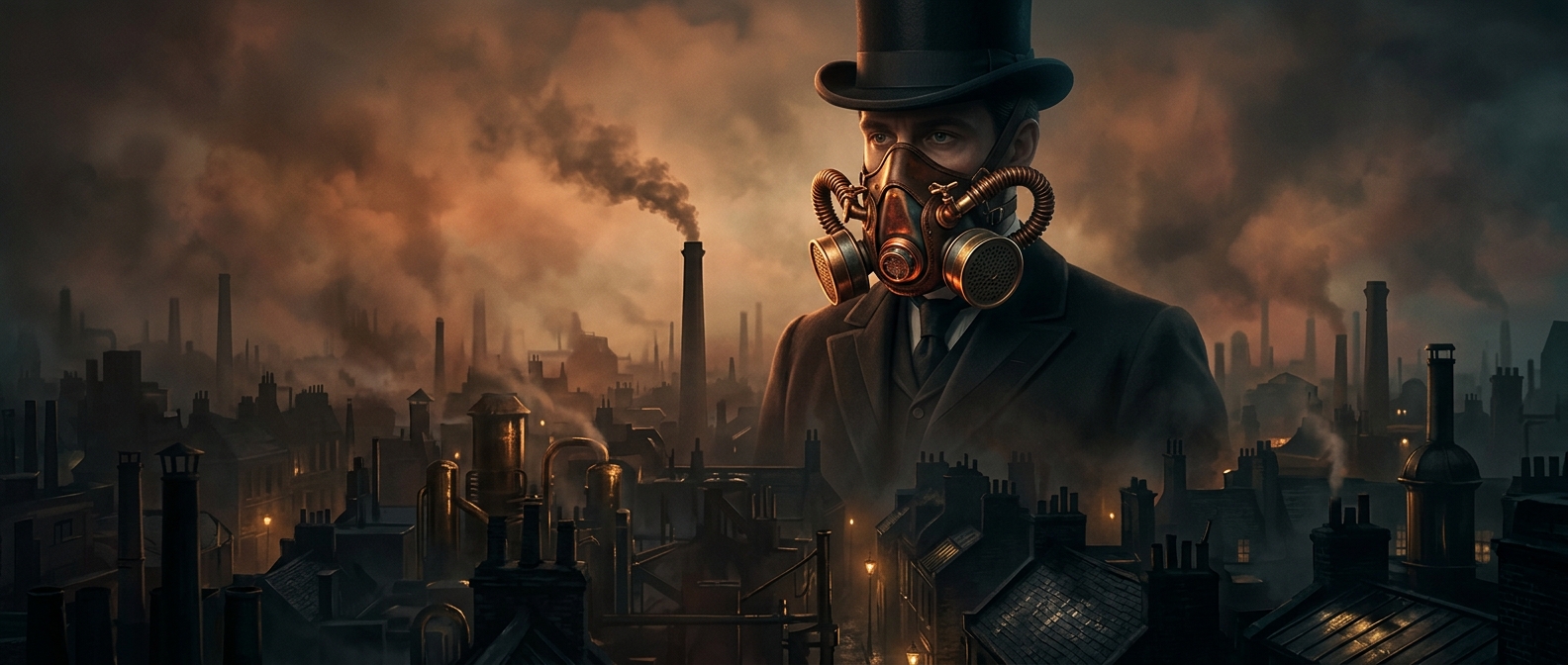
What a street-level filter could catch
In Victorian London, coal smoke was more than a distant haze. Fires in homes and workshops sent soot and fine particles into the air, where they could irritate the eyes and airways and settle on clothing and buildings. A wearable filter aimed to intercept some of that material before it reached the nose and mouth.
Wool and damp or dry sponge worked as porous barriers: air could pass through their tangled openings, while some larger particles lodged in the fibers. Charcoal offered a different property. Its highly porous surface could hold certain vapors and odors, though that did not make a simple charcoal mask a dependable shield against every harmful component of smoke.
The hard part was breathing through it
A filter only helps if air goes through the filtering material rather than around its edges. It also has to let enough air through comfortably. As soot collected, a filter could clog and become harder to breathe through; a loose fit could let polluted air bypass it altogether. These were practical limits for devices worn during ordinary travel, not just for brief use in controlled conditions.
The masks therefore made a tangible attempt to manage a problem people encountered outdoors, but they could not clean the air of an entire city. Their significance lies in that shift in scale: instead of treating smoke only as a nuisance to be endured, inventors tried to put a barrier between London’s dirty air and an individual’s lungs.