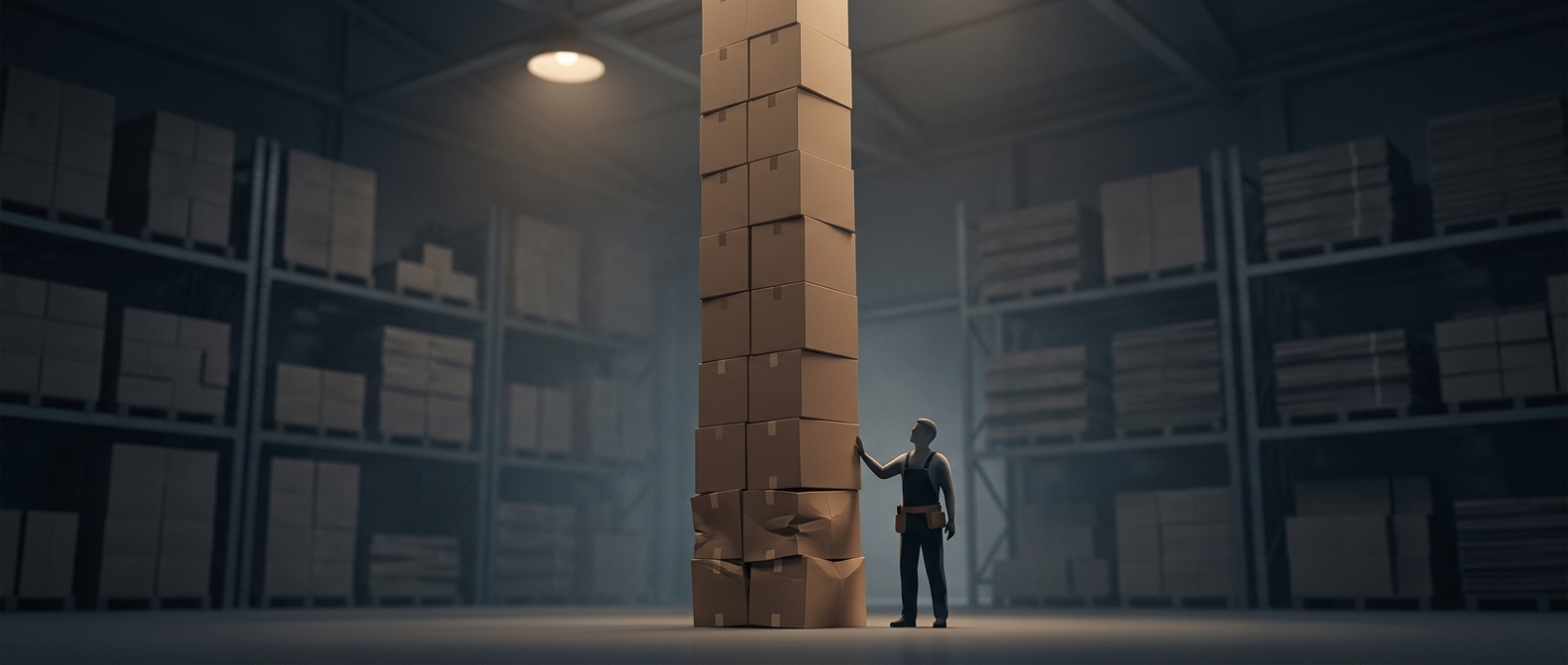
How corrugated cardboard carries a stack
Shipping boxes are usually made from corrugated board: flat paper sheets sandwich a wavy layer called a flute. That wave acts like a row of tiny columns. When a box is stacked upright, the columns help resist the downward squeeze and keep the sides from buckling.
Thicker board can use taller flutes, heavier paper, or additional layers. These add stiffness and help a box hold its shape under load. But thickness alone does not determine strength: the paper’s quality, the flute design, the box’s dimensions, and how well its seams are made all matter. A broad box, for example, may bow more easily than a compact one built from similar board.
Why the journey changes the calculation
A box is strongest when its walls stay dry and its load is spread evenly. Damp paper softens, while a dent, poorly aligned stack, or heavy item pressing on a small area can concentrate force and start a collapse. During a long shipment, boxes may remain stacked for days, so designers have to account for sustained pressure—not just the brief impact of setting one box down.
That is why packaging is matched to both the product and the route. A light, sturdy item may need little protection from stacking; a heavier item or a long ocean journey may call for stronger board and a more supportive box shape. The goal is not simply to make cardboard thick, but to keep the bottom box’s walls from losing their column-like support before the shipment reaches its destination.