Why a Small Ant Can Carry a Large Load
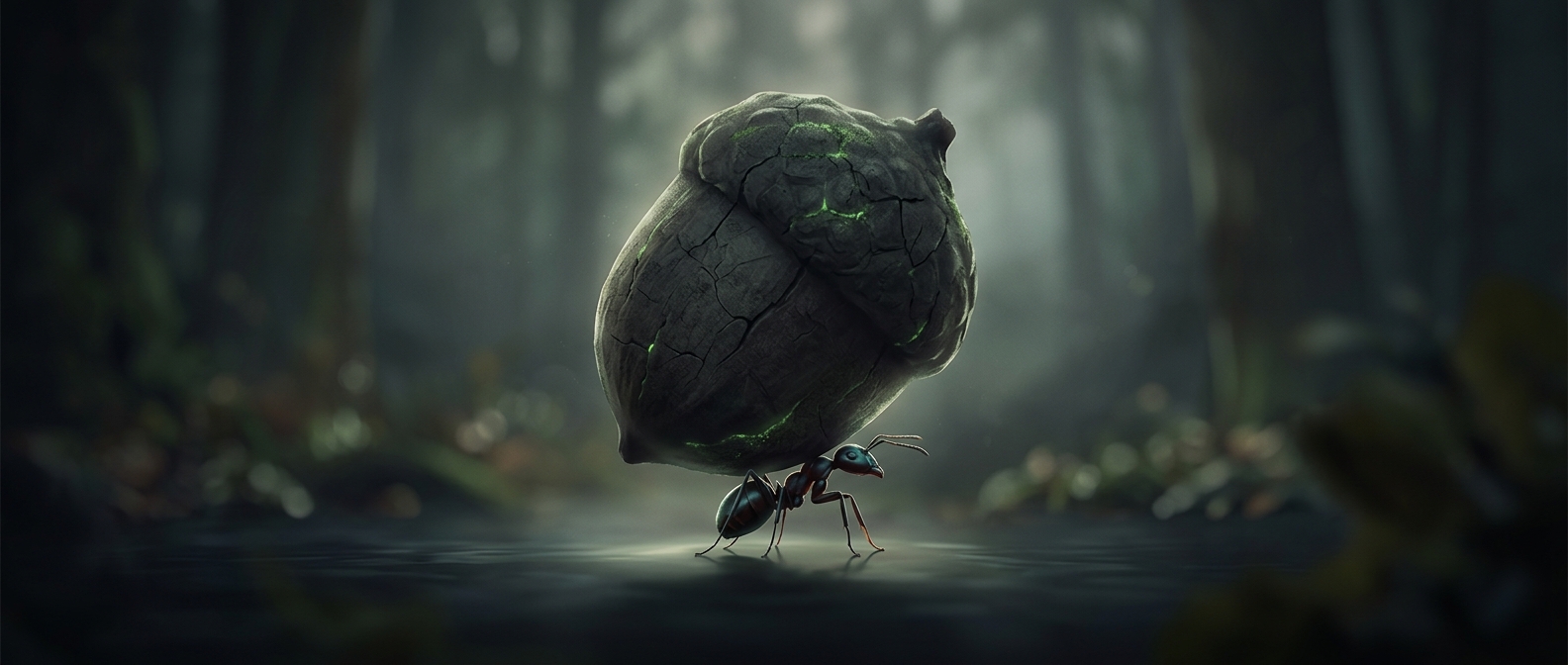
An ant’s strength is impressive only when measured against its own size. A worker ant may grip and move an object that outweighs it, but the feat depends on having a very small body—not on possessing muscles that would be extraordinarily powerful at human scale.
Muscles produce force through their cross-sectional area: roughly, the area across the muscle fibers pulling on a limb. Body weight, by contrast, depends on volume. As an animal’s dimensions increase, area grows with the square of its size, while volume grows with the cube. That means weight rises faster than the force muscles can produce.
What Changes as an Animal Gets Bigger
Imagine enlarging an ant while keeping its proportions the same. Its limbs and muscles would become thicker, so their force would increase. But the ant’s body would gain weight even faster, and each leg would have more mass to support. The enlarged animal would also face greater stresses as it stood and moved; simply scaling up its exoskeleton would not preserve the original balance of support and load.
This is why a human-sized ant would not be able to keep lifting in proportion to its body weight. Its strength-to-weight advantage would shrink, and ordinary movement could become a serious mechanical challenge. A larger animal needs a different build—especially thicker supporting limbs and a body plan suited to carrying more mass.
The Advantage—and Its Limit
At tiny sizes, an ant’s own weight is low relative to the force its muscles can exert, so a heavy object can still be manageable. The familiar “many times its own weight” comparison captures that small-scale advantage, not a universal measure of muscle power.
Scale the body up, and the same proportions stop working. The ant’s strength is real, but it belongs to the physics of being small.