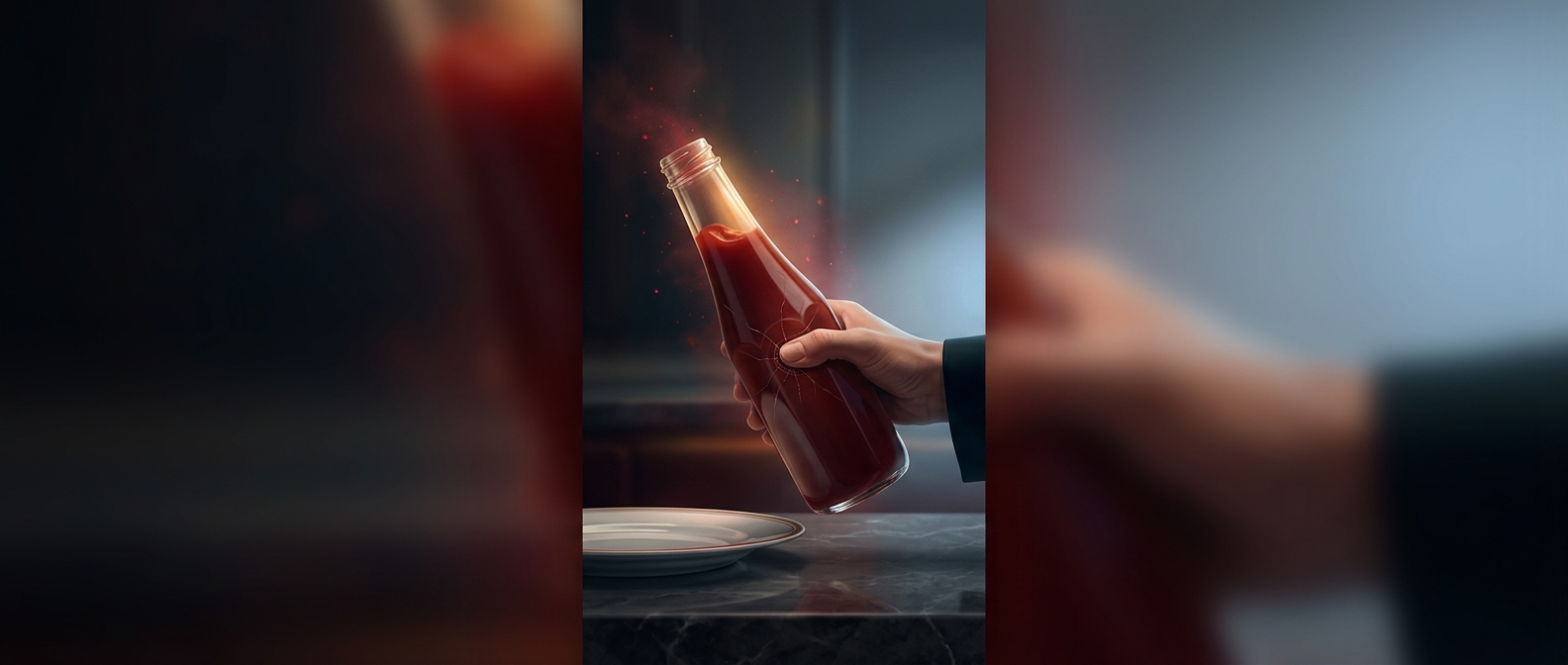
Why a small tap can start a ketchup pour
Ketchup behaves differently from a simple liquid such as water. It is a shear-thinning fluid: when it is still, its ingredients form a structure that resists flowing; when force is applied, that structure gives way and the ketchup moves more easily. The minimum force needed to get it moving is called its yield stress.
Inside an upside-down bottle, gravity is already pulling the ketchup toward the opening, but the thick condiment may remain stuck in place. A sharp tap sends a brief jolt through the glass, disturbing the ketchup and helping it overcome that resistance. Once it starts moving, the flow itself makes it easier for more ketchup to follow.
Why the mark matters
An embossed mark gives the user a target for the tap, making it easier to apply the jolt in a consistent spot rather than striking randomly. It does not thin the ketchup or act like a valve; it helps trigger movement in a material that resists starting but flows more readily once it is underway.
That is why a well-aimed tap can work better than shaking the bottle repeatedly: the goal is not to keep the ketchup in motion, but to get it past the point where gravity can take over.