Why Star Wars Was Hard to Pitch
George Lucas’s early Star Wars story was not yet the familiar film in polished form. It drew on space adventure, westerns, samurai stories, and myth, while introducing readers to a sprawling galaxy through unfamiliar names and concepts. A farm boy, a mystical warrior, and a masked, machine-assisted villain could sound like pieces from different movies rather than parts of one coherent story.
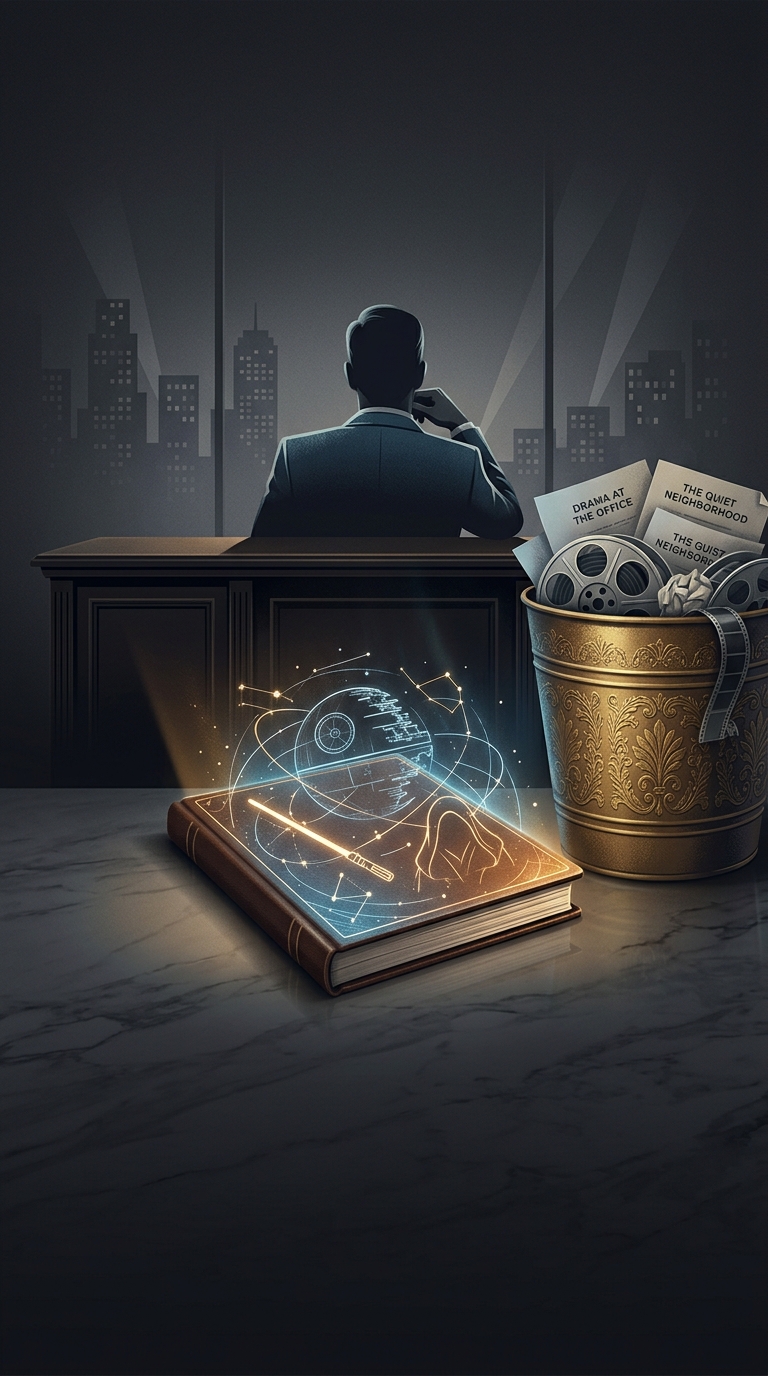
That made the pitch a challenge: executives had to imagine not only the plot, but also a screen world that had few close precedents in big-budget filmmaking. The description of a “giant metal moon,” for example, compresses a major story reveal into a phrase that may sound more like a military weapon than a setting for a dramatic confrontation.
The Story Had to Become a Film
A script can explain events in words; a movie must make its invented world instantly legible through images, performances, sound, and editing. Lucas’s task was to turn an unfamiliar vocabulary into things an audience could recognize at a glance: a farm boy’s longing to leave home, a mentor’s lessons, a threatened princess, and a weapon capable of destroying a planet.
The project’s eventual path depended on someone at 20th Century Fox deciding that this unusual material could work on screen. The broader lesson is that a story’s difficulty in a meeting is not the same as its difficulty for an audience. Once the film gave its strange machinery and mythology vivid, concrete form, the premise that had sounded confusing could be understood in a single image: a small fighter racing toward a moon-sized weapon.