Why Gatling imagined fewer soldiers
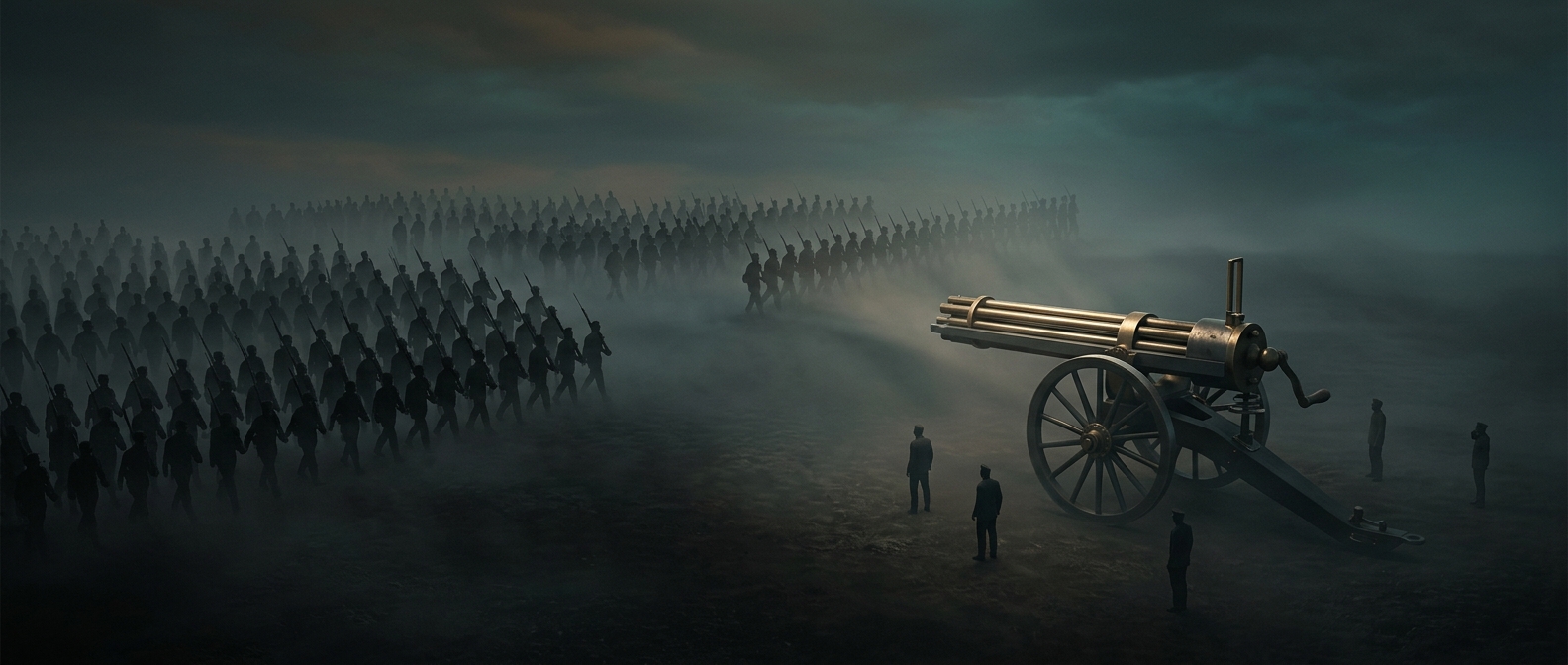
Richard Gatling’s idea rested on a powerful arithmetic: if one person could deliver the fire of many, an army might need fewer people in the firing line. His crank-operated gun used several barrels that rotated as the operator turned a handle, allowing shots to be fired in rapid succession. The machine concentrated a large amount of firepower in the hands of a small crew.
The hoped-for benefit was not simply convenience. Gatling believed that a weapon capable of overwhelming an enemy could make battles so costly that governments would have less reason to send large armies into them. In that vision, greater destructive power might prevent the fighting it could otherwise intensify.
Why armies did not shrink
A weapon can replace some labor without replacing an army’s basic jobs. Soldiers still have to move through difficult terrain, protect supply lines, capture positions, and hold territory after the shooting stops. A rapid-fire gun could strengthen a unit, but it could not occupy a road or defend a broad front on its own.
And military advantage is relative. Once one side fields a more powerful weapon, the other has reason to match it, find ways around it, or bring more troops and resources to the contest. The gun changed what soldiers could do; it did not remove the need to deploy them.
The opposite of the promised economy
The result was a familiar military tradeoff: more firepower did not automatically mean less war. In battle, a weapon that could pour shots into an exposed group made massed movement more dangerous. The same concentrated force that seemed capable of ending a fight quickly could make an attack far deadlier when it did not end the fight.
Gatling’s hope treated battlefield efficiency as a way to reduce the human cost of war. Armies instead absorbed the new capacity into their existing systems. The machine could make one soldier’s fire count for more, but it could not make armies’ political and territorial purposes disappear.