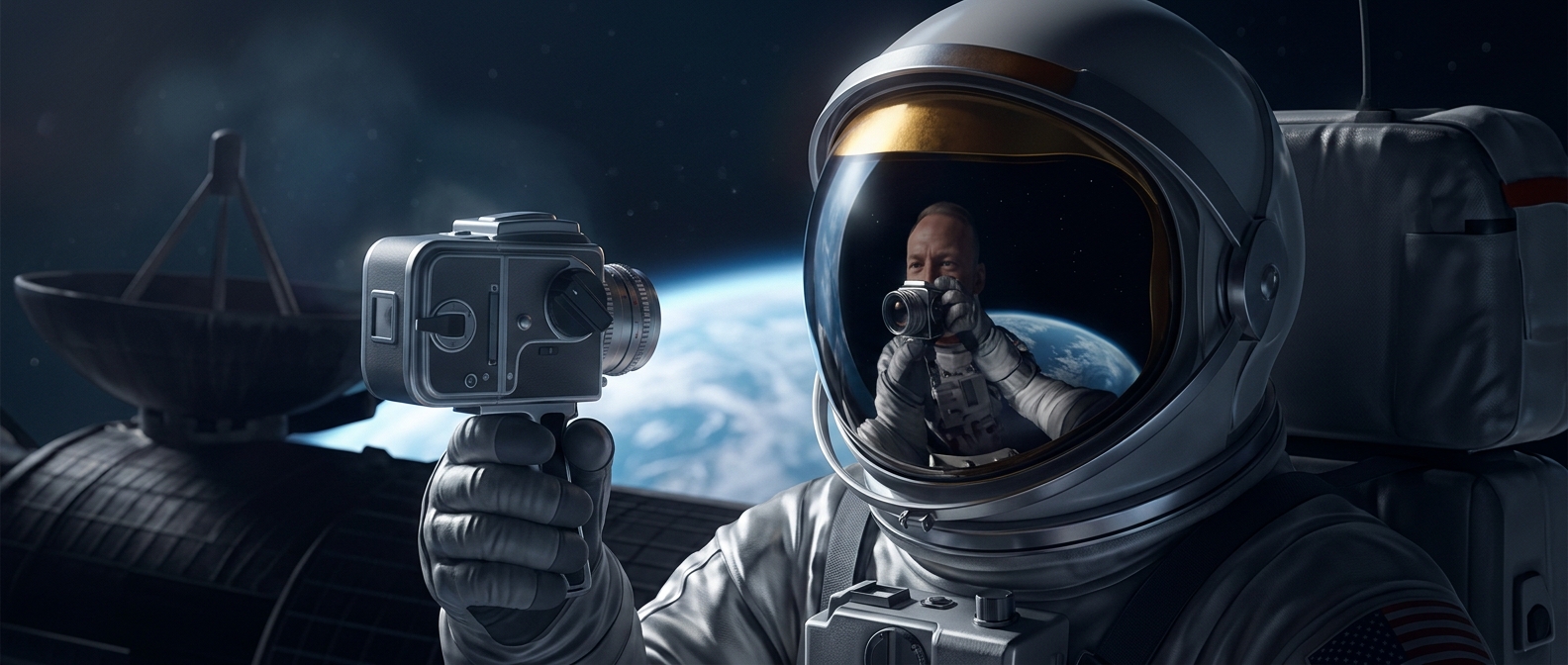
A self-portrait without a viewfinder
Aldrin’s photograph was a practical feat as much as a novelty. In 1966, a space camera was a film camera: it could not show him a live preview or confirm whether the shot was framed. Wearing a pressurized spacesuit, he had to aim it by feel, while the helmet and gloves that kept him alive made ordinary camera handling awkward.
The picture’s appeal comes partly from what the camera could include. Aldrin appears in his helmet, with the Earth behind him—a view that turns a personal snapshot into a record of the setting in which it was made. There was no easy way to check the composition and try again on the spot.
A photograph from a working mission
Gemini 12 was not staged as a photo shoot. NASA’s Gemini program was testing the skills and equipment astronauts would need for later missions, including work outside a spacecraft. During an activity known as a spacewalk, an astronaut had to manage a suit, tools, and movement while remaining connected to the vehicle.
That context gives the selfie its historical edge: the camera was an ordinary tool brought into an extraordinary workplace. Aldrin’s frame preserved not only his face, but a moment when taking a picture meant maneuvering a bulky camera in a spacesuit, with Earth beyond the hatch.