Why Saturn Grew Two “Ears”
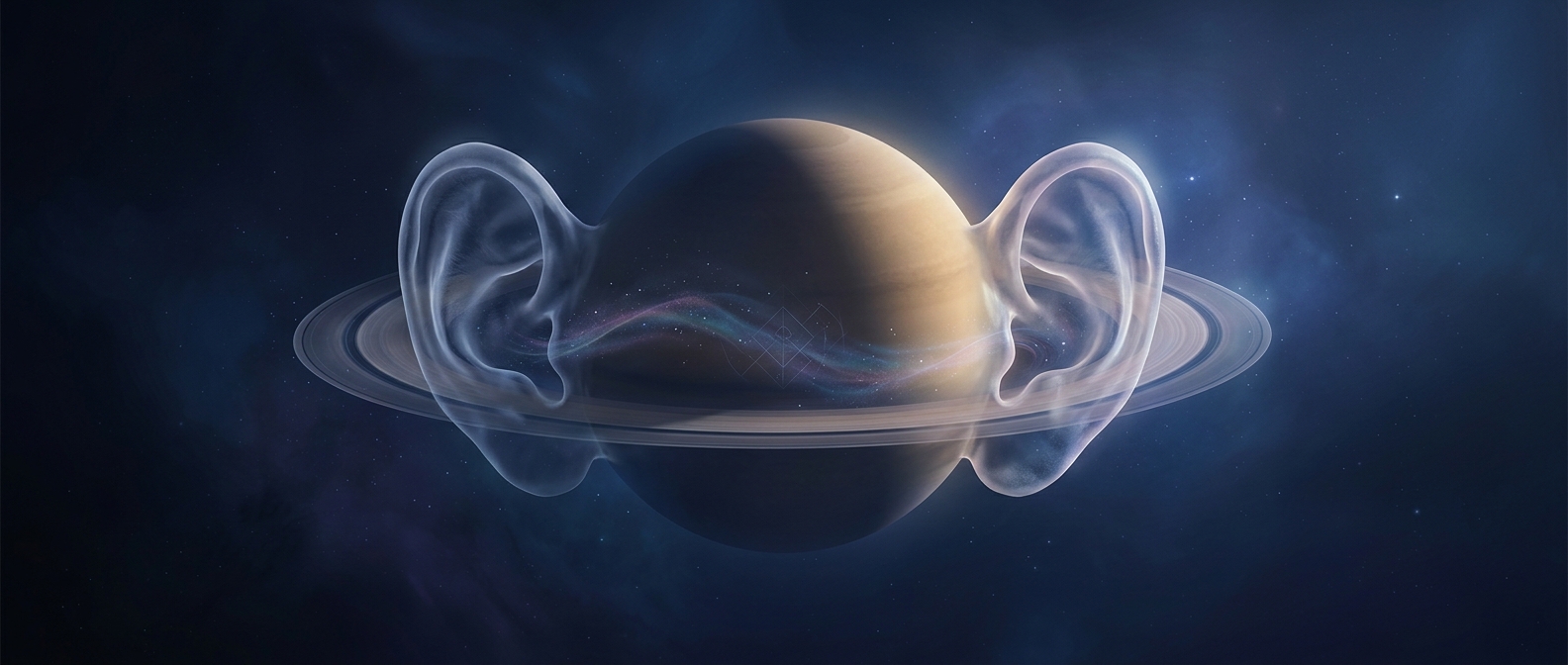
Through an early telescope, Saturn did not look like a planet neatly surrounded by a ring. The instrument gathered too little detail to separate the narrow ring from the planet, and its imperfect optics blurred the combined image. The ring’s outer parts showed up as two bulges on either side—like handles or ears attached to a central globe.
That was an optical limit, not a failure of imagination. A telescope can magnify an image without resolving fine detail: if its optics cannot distinguish nearby features, magnification simply makes the blur larger. Saturn’s rings were too close to the planet, as seen in the telescope’s image, to appear as a clean, separate structure.
From a Strange Shape to a Ring
As telescopes improved, observers could make out more of the geometry. In the mid-17th century, Christiaan Huygens proposed that Saturn was encircled by a thin, flat ring. That explanation made sense of the changing appearances: depending on the ring’s tilt toward Earth, it could look broad, narrow, or nearly disappear when viewed edge-on.
The change in interpretation came from resolving what the earlier image had fused together. What looked like two appendages was the visible edge of a vast ring system made of orbiting debris. The “ears” were a record of the telescope’s limits—and of how much a clearer view can change the question observers think they are asking.