The comet in the records
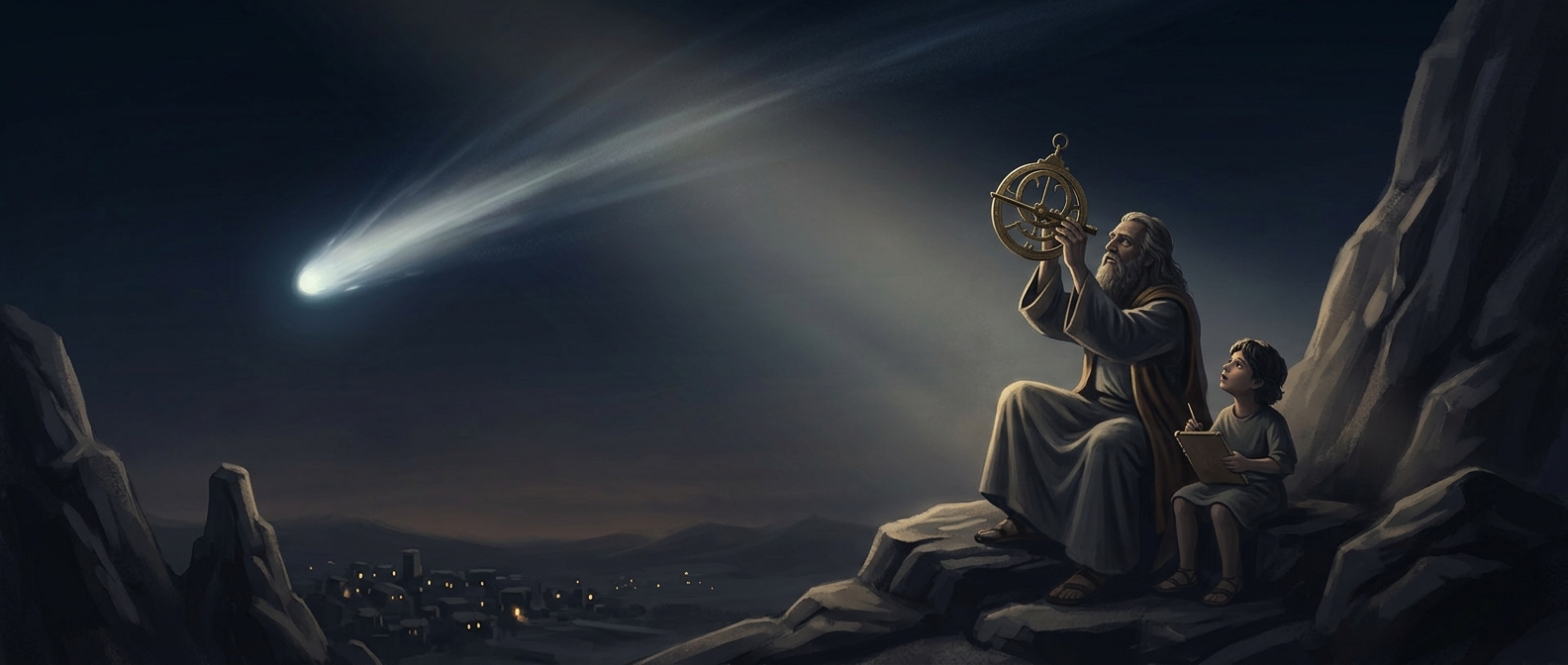
Before astronomers knew that comets could return, each bright visitor seemed like a new event. People recorded comets in chronicles and other observations, often noting when they appeared and where they crossed the sky. But a record of one apparition—the term for a comet’s visible visit—did not by itself reveal whether the same object had appeared before.
The sightings were separated by years and generations, and the descriptions were made without a shared system for identifying a comet’s path. To connect them, someone had to compare accounts across time and ask whether their differences could be explained by changes in the comet’s position and by the limits of the observations.
Halley’s leap was a prediction
Edmond Halley examined records of earlier comets and found that several appearances could fit the return of one object. The key was not simply that the comets looked alike: their paths and timing suggested a repeating orbit, the route an object follows around the Sun. Halley used this pattern to predict that the comet seen in 1682 would come back.
When it reappeared in 1758, after Halley’s death, that return supported his identification. The object became known by his name, but he had not discovered the comet in the sense of being the first person to see it. His lasting achievement was recognizing a recurring visitor where generations had seen separate events.
Recognition changed what a comet meant
That shift turned old observations into evidence about a system. A comet no longer had to be treated as a one-time spectacle; its past appearances could help estimate when it would return. The comet had already been famous for millennia. What was new was the idea that a sighting could be part of a schedule—and that the sky’s apparent surprises might have a history that could be read.