Why a clown’s face can be a signature
A clown’s makeup is more than a costume choice. The shapes around the eyes, the mouth, and the brows can make one performer recognizable even before the audience sees the rest of the costume. That makes a distinctive design worth documenting—and vulnerable to copying.
Why record it on a ceramic egg?
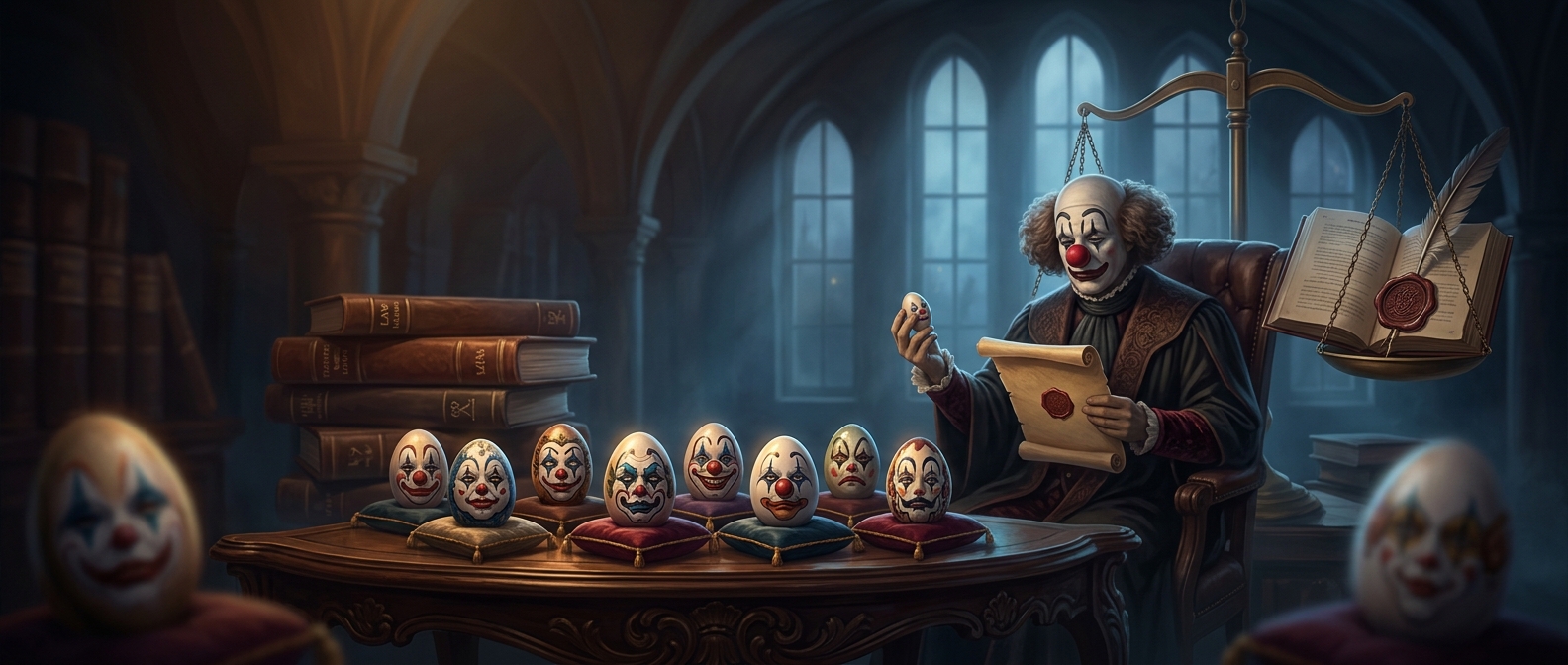
A registry gives each design a physical record: the performer paints the makeup onto a hollow ceramic shell shaped like an egg. Its rounded surface serves as a small stand-in for a human face, letting the pattern be viewed as a continuous design rather than as a flat sketch. The shell can also be stored and handled without the design depending on a performer’s face or a temporary application of makeup.
Keeping these records helps establish which designs performers have claimed as their own and gives them something concrete to point to if another clown adopts a notably similar look. Registration is not, by itself, a guarantee that every imitation can be stopped; its practical value is that it makes the design—and its association with a performer—harder to dismiss as an unrecorded idea.
The result is an unusually tangible archive of performance identity: a row of ceramic faces preserving the visual signatures that audiences normally see only under stage lights.