Why a Highway Dash Can Measure Ten Feet
A broken lane line is not a short dash repeated at random. In a common U.S. highway pattern, each painted stripe is about ten feet long, followed by about thirty feet of bare pavement. That spacing makes the line easy to read as a repeating boundary while leaving most of the road surface unpainted.
Motion Shrinks What You See
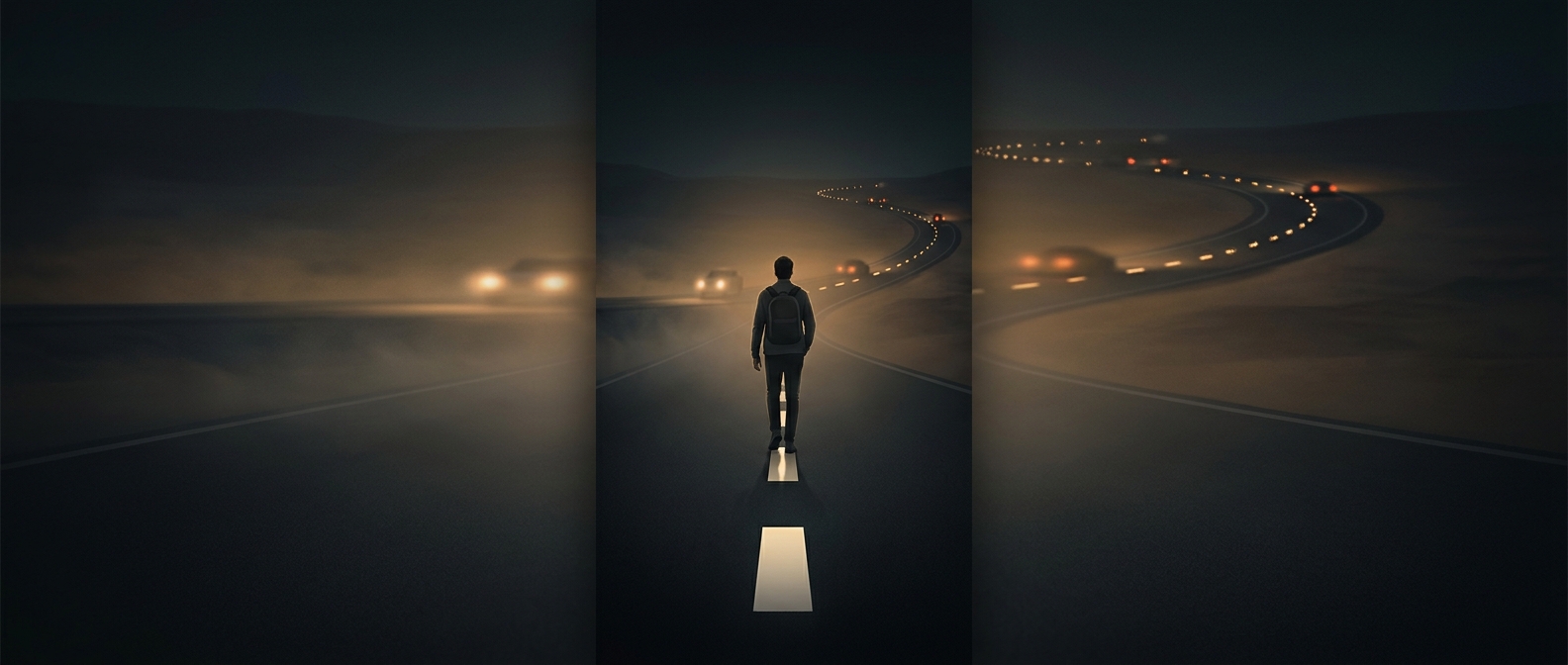
From the driver’s seat, a stripe is visible for only a moment before it slips under the car. Your eyes also judge it against a road stretching far into the distance: perspective compresses the apparent size of pavement markings farther ahead, and the brief view of each stripe makes its length hard to estimate. The stripe may look like a small dash even though it spans roughly the length of a large car.
The gap reinforces the illusion. Because the unpainted interval is three times as long as the stripe, the eye registers a rhythm of short marks rather than one long piece of paint. At highway speed, those marks arrive and disappear too quickly for a casual glance to measure them.
A Pattern Built for Recognition
The alternating stripe-and-gap pattern gives drivers a continuous visual cue without covering the lane in paint. It also makes the boundary legible as the road recedes: individual marks merge into a steady line at a distance, then resolve into separate segments as the vehicle approaches.
The next time a lane dash flashes beneath the car, its apparent size is a reminder that roadside perspective is a poor ruler: the “little” stripe is about ten feet of pavement.