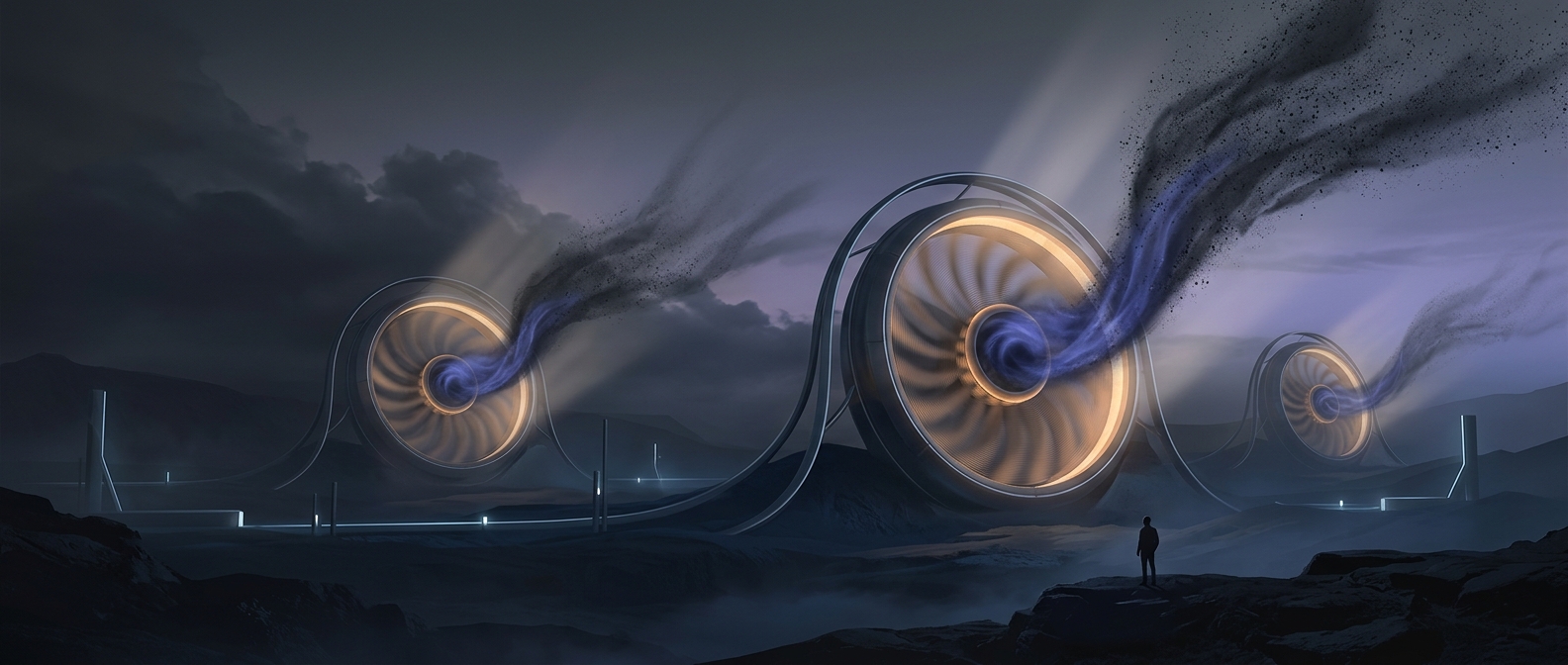
How direct-air capture turns a thin trace into a storable stream
Carbon dioxide is spread so thinly through ordinary air that capturing it is a very different job from removing it from the concentrated exhaust of a factory. A direct-air-capture plant must bring a great deal of air into contact with a material that selectively holds CO₂ while letting most other gases pass.
That material, called a sorbent, may be a solid coating or a liquid chemical. As air passes over it, CO₂ sticks to or reacts with the sorbent. The fan is only the first part of the process: once the sorbent is loaded, the plant has to release the gas again in a controlled space.
The capture material has to be reset
Operators regenerate the sorbent—freeing the captured CO₂—by changing conditions such as temperature, pressure, or moisture, depending on the system. This produces a much more concentrated stream than the air that entered. The sorbent can then be used again, while the separated gas is prepared for transport and underground storage.
That cycle is central to the technology’s design. Moving air takes power, and releasing CO₂ from the sorbent takes energy too. A plant’s climate benefit therefore depends not just on how much gas it captures, but also on the energy it uses and whether that energy is low-carbon.
Why the destination matters
Capture alone does not make the removal permanent. If the concentrated CO₂ is stored securely underground, it can be kept out of the atmosphere for a long time; if it is used in a way that soon releases it, the climate benefit is different. The fans, sorbent, regeneration equipment, and storage route work as one chain. A weak link—especially energy-intensive operation powered by fossil fuels—can shrink the amount of carbon the system truly removes.