The fungal question behind Potter’s drawings
Before Beatrix Potter became known for Peter Rabbit, she investigated a problem that was difficult to see with the naked eye: how mushrooms begin a new generation. Mushrooms release spores, tiny reproductive cells that can grow into fungal threads under suitable conditions. Those threads later develop into the structures that produce more spores.
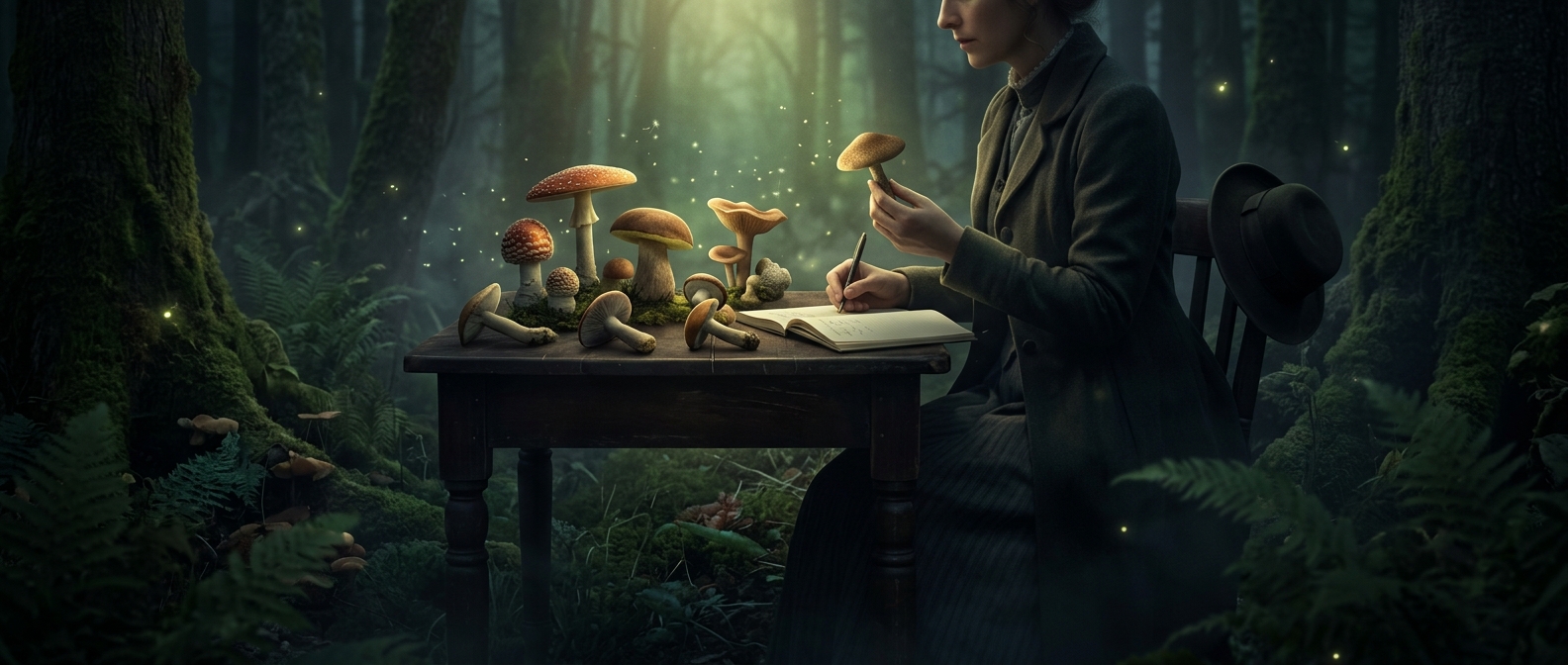
Potter examined spores under a microscope and tried to observe their germination—their first growth after settling in a favorable environment. This mattered because fungi can look very different at different stages, making it hard to tell which forms belong to the same organism. Careful observation could help clarify how mushrooms reproduce and how they should be classified.
A scientific paper without a scientific welcome
In 1897, Potter submitted a paper on her observations to the Linnean Society, a leading scientific organization devoted to natural history. But women were excluded from the Society’s meetings and from the professional networks through which scientists presented, debated, and established their work. Her findings did not receive the recognition a paper from a male colleague might have gained.
That barrier shaped what could happen to the research: scientific claims were judged not only through experiments, but also through institutions that decided whose work merited attention. Potter’s botanical skill remained real, even when the scientific establishment gave it little public standing.
The same eye, a different audience
Potter’s close study of natural forms later served her illustration. She drew animals and plants with an attention to anatomy, texture, and behavior that made her imagined stories feel grounded in the living world. The shift from fungal research to children’s books was not a shift away from observation; it gave that skill a much larger audience.
Her mushroom studies are a reminder that the drawings behind a beloved story grew out of serious work—and that a scientific contribution can be overlooked even when its maker has done the patient work of looking closely.