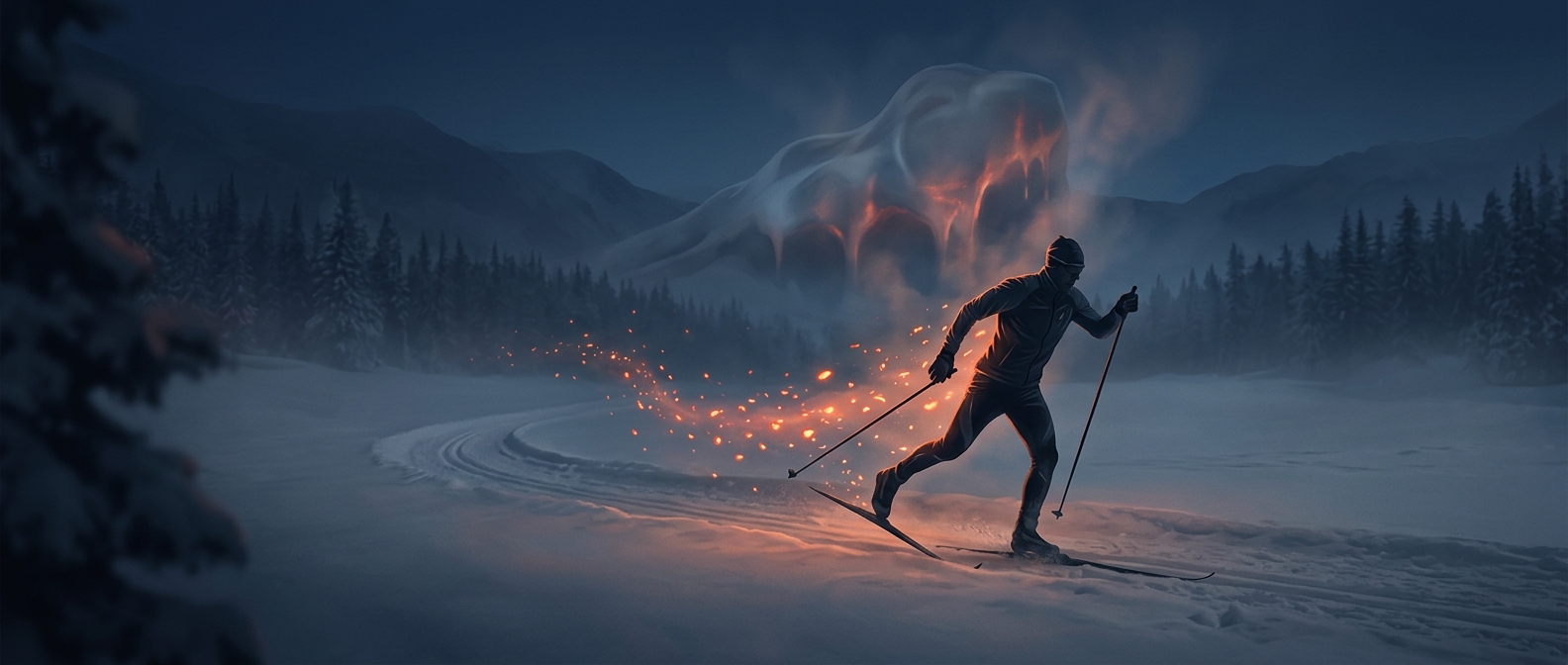
Why skiing across snow demands so much work
On skis, forward motion comes from repeated pushes rather than a motor. In classic style, a skier presses one ski back against the snow while gliding on the other; in skating style, each ski pushes diagonally outward. Either way, the legs must generate the force that keeps the skier moving, while the arms and poles add another push.
That effort is especially continuous on rolling terrain. A skier may glide briefly, but must keep producing force to regain speed lost to snow friction, steer, and crest small rises. On an uphill, gravity pulls the skier backward, so each stride has to lift and propel the body forward at once.
Balance turns each stride into a whole-body task
A narrow ski offers little room for error. The skier shifts weight from one gliding ski to the other, stabilizing the torso and hips while coordinating the legs, arms, and poles. Those adjustments are small, but they recur with every stride. Poles are not just for balance: planted at the right moment, they help drive the body forward, engaging the shoulders and upper arms as well as the legs.
The result is a sustained effort that recruits large muscle groups and leaves little time for complete rest between pushes. The energy cost comes not from one dramatic climb, but from repeating propulsion, balance, and terrain-adjusted effort across the route. A gentle-looking trail can therefore keep a skier working steadily even when no single hill seems steep.