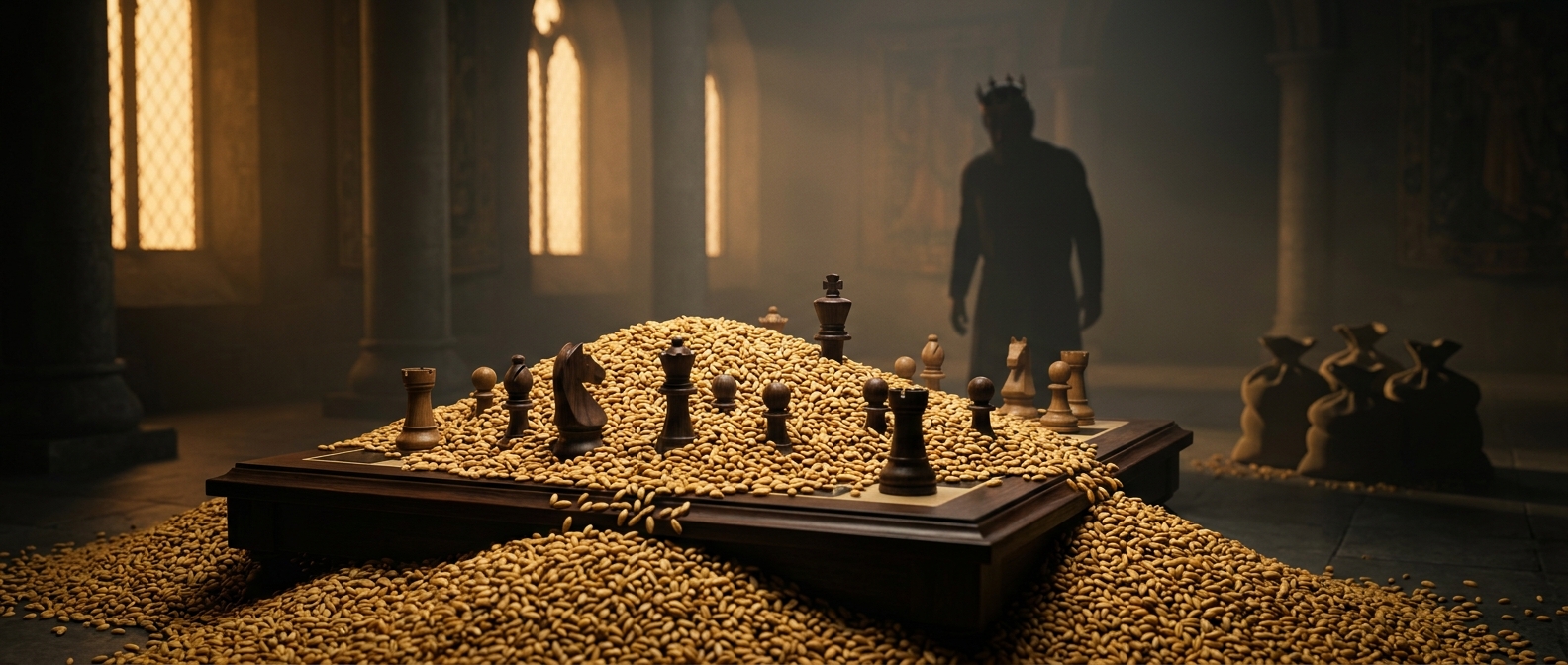
Why the last squares overwhelm the first
The demand grows by a factor of two at every step: 1 grain, then 2, then 4, then 8. By the time the count reaches the 64th square, that single square calls for 9,223,372,036,854,775,808 grains. The first few squares seem trivial; the final ones dominate the bargain.
The total across the whole board is one less than twice the final square’s amount: 18,446,744,073,709,551,615 grains. That compact rule comes from adding a doubling sequence: each new term is as large as all the earlier terms combined, plus one. So the first 32 squares contain only a tiny fraction of the full demand; the second half supplies nearly all of it.
A lesson in exponential growth
This is exponential growth: a quantity that increases by the same multiplier each step, rather than by the same fixed amount. If the king had been asked for one additional grain on each square, the request would have reached just 64 grains. Doubling instead makes each square a much larger commitment than the one before it.
That difference is easy to miss when the first terms are small. A promise can appear affordable for a long time, even as its later obligations accelerate beyond any practical supply. The legend’s punchline is not that the king miscounted a few grains; it is that he agreed to a rule whose final steps mattered more than everything that came before.